巴菲特致股東函 2018


巴菲特致股東函 2018
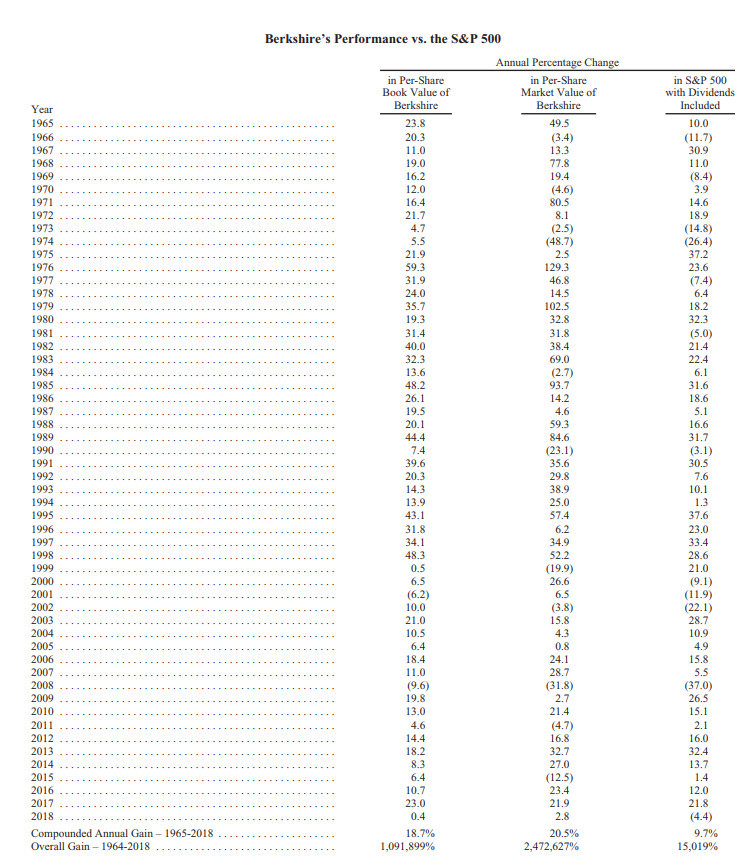
Note: Data are for calendar years with these exceptions: 1965 and 1966, year ended 9/30; 1967, 15 months ended 12/31. Starting in 1979, accounting rules required insurance companies to value the equity securities they hold at market rather than at the lower of cost or market, which was previously the requirement. In this table, Berkshire’s results through 1978 have been restated to conform to the changed rules. In all other respects, the results are calculated using the numbers originally reported. The S&P 500 numbers are pre-tax whereas the Berkshire numbers are after-tax. If a corporation such as Berkshire were simply to have owned the S&P 500 and accrued the appropriate taxes, its results would have lagged the S&P 500 in years when that index showed a positive return, but would have exceeded the S&P 500 in years when the index showed a negative return. Over the years, the tax costs would have caused the aggregate lag to be substantial.

To the Shareholders of Berkshire Hathaway Inc.:
波克夏·海瑟威的各位股東們好:


Berkshire earned $4.0 billion in 2018 utilizing generally accepted accounting principles (commonly called “GAAP”). The components of that figure are $24.8 billion in operating earnings, a $3.0 billion non-cash loss from an impairment of intangible assets (arising almost entirely from our equity interest in Kraft Heinz), $2.8 billion in realized capital gains from the sale of investment securities and a $20.6 billion loss from a reduction in the amount of unrealized capital gains that existed in our investment holdings. 
2018年當中,波克夏的通用會計準則(GAAP)盈利總計為40億美元。具體而言,這當中包括248億美元運營盈利,30億美元源於無形資產受損的非現金虧損(幾乎全部來自卡夫亨氏的持股),28億美元的來自已售出投資證券的兌現資本利得,以及206億美元的“虧損”,後者是來自我們依然持有的投資的未兌現資本利得減少。

A new GAAP rule requires us to include that last item in earnings. As I emphasized in the 2017 annual report, neither Berkshire’s Vice Chairman, Charlie Munger, nor I believe that rule to be sensible. Rather, both of us have consistently thought that at Berkshire this mark-to-market change would produce what I described as “wild and capricious swings in our bottom line.”
根據新GAAP規則的要求,我們必須將這最後一項納入我們的盈利數據。正如我在2017年財報當中所強調過的,無論是波克夏的副董事長孟格(Charlie Munger),還是我本人都覺得這種規則是沒有道理的,相反,在我們看來,對於波克夏而言,這種要求逐日盯市的改變只能造成我所謂的“我們盈利的狂野而變化無常的震蕩”。

The accuracy of that prediction can be suggested by our quarterly results during 2018. In the first and fourth quarters, we reported GAAP losses of $1.1 billion and $25.4 billion respectively. In the second and third quarters, we reported profits of $12 billion and $18.5 billion. In complete contrast to these gyrations, the many businesses that Berkshire owns delivered consistent and satisfactory operating earnings in all quarters. For the year, those earnings exceeded their 2016 high of $17.6 billion by 41%.
事實上,我們2018年每個季度的財報可以說都在證明我這種預言的準確性。比如,在第一和第四季度當中,我們分別報告了11億美元和254億美元的GAAP“虧損”。第二和第三季度,我們又分別報告了120億美元和185億美元的“利潤”。然而在現實層面,波克夏旗下的諸多企業 “全部”四個季度當中,其實都交付出了具有持續性的,令人滿意的運營盈利。就這一年全年而言,這種盈利在2016年的176億美元高點上又前進了41%。
Wide swings in our quarterly GAAP earnings will inevitably continue. That’s because our huge equity portfolio – valued at nearly $173 billion at the end of 2018 – will often experience one-day price fluctuations of $2 billion or more, all of which the new rule says must be dropped immediately to our bottom line. Indeed, in the fourth quarter, a period of high volatility in stock prices, we experienced several days with a “profit” or “loss” of more than $4 billion.
我們每個季度的GAAP盈利的狂野波動必然還將繼續下去。這是因為我們投資組合的規模龐大——截至2018年底,價值近1730億美元,一天之內就縮水或者膨脹20億美元乃至更多,完全是家常便飯,但是新規則卻要求我們將這種變化當即落實到我們的盈利數字當中。事實就是,在去年第四季度那段股價波動極端劇烈的時期,我們至少有七天的“利潤”或者“虧損”都超過了40億美元。
Our advice? Focus on operating earnings, paying little attention to gains or losses of any variety. My saying that in no way diminishes the importance of our investments to Berkshire. Over time, Charlie and I expect them to deliver substantial gains, albeit with highly irregular timing.
如果各位股東要問我們能夠提供什麽建議,回答是,大家最好專注於運營盈利,不要去在意任何其他一種利得或者虧損。我要說的是,大家對波克夏的投資的重要性不會因為量度的變化而有實質性的改變。長期而言,查理和我預計這些投資都將貢獻出持續的利得——儘管在不同的時間節點,它們看上去可能會很怪異。 

* * * * * * * * * * * *
Long-time readers of our annual reports will have spotted the different way in which I opened this letter. For nearly three decades, the initial paragraph featured the percentage change in Berkshire’s per-share book value. It’s now time to abandon that practice.
長期關注我們年報的人們可能已經發現,這一封股東信的開篇和許多往年都有所不同。在長達近三十年的時間當中,我們在最初的段落裡都是主要談論波克夏每股帳面價值的變化。可是現在,我們是時候改弦更張了。

The fact is that the annual change in Berkshire’s book value – which makes its farewell appearance on page 2 – is a metric that has lost the relevance it once had. Three circumstances have made that so. First, Berkshire has gradually morphed from a company whose assets are concentrated in marketable stocks into one whose major value resides in operating businesses. Charlie and I expect that reshaping to continue in an irregular manner. Second, while our equity holdings are valued at market prices, accounting rules require our collection of operating companies to be included in book value at an amount far below their current value, a mismark that has grown in recent years. Third, it is likely that – over time – Berkshire will be a significant repurchaser of its shares, transactions that will take place at prices above book value but below our estimate of intrinsic value. The math of such purchases is simple: Each transaction makes per-share intrinsic value go up, while per-share book value goes down. That combination causes the book-value scorecard to become increasingly out of touch with economic reality.
事實就是,波克夏帳面價值的年度變化——在第二頁會和大家做一個告別——作為一個指標而言,已經不再像過去那樣至關重要了。這是環境的變化使然。首先,波克夏已經逐漸蛻變,從一家全部資產主要集中於可銷售股票當中的公司變化為一家主要價值來自於運營業務的公司。查理和我估計,這種公司的重塑將以一種不規則的方式繼續下去。其次,當下的會計準則儘管要求我們將持有的股票逐日盯緊市場來定價,但是對我們的運營企業,卻要求其以遠低於當前價值的帳面價值來入帳,這種錯誤的影響近年以來變得日益嚴重。第三,從長期角度看來,波克夏很可能會成為一個自身股票的重量級回購者,當股票價格高於帳面價值而又低於我們估計的內在價值時,回購就會發生。這種回購背後的計算邏輯非常簡單——每一筆交易都會使得每股內在價值提高,同時使得每股帳面價值降低。兩者交相作用,就會使得記錄在案的帳面價值日益遠離我們的經濟現實。

In future tabulations of our financial results, we expect to focus on Berkshire’s market price. Markets can be extremely capricious: Just look at the 54-year history laid out on page 2. Over time, however, Berkshire’s stock price will provide the best measure of business performance.
在波克夏未來的財務業績報告當中,我們預計會專注於其市場價格。市場完全可能是極端反覆無常的——看看我們第二頁列出的54年歷史記錄,大家就會有一個最直觀的印象。不過,若是著眼於長期,波克夏的股價確實是我們業務表現的最佳指標。

* * * * * * * * * * * *
Before moving on, I want to give you some good news – really good news – that is not reflected in our financial statements. It concerns the management changes we made in early 2018, when Ajit Jain was put in charge of all insurance activities and Greg Abel was given authority over all other operations. These moves were overdue. Berkshire is now far better managed than when I alone was supervising operations. Ajit and Greg have rare talents, and Berkshire blood flows through their veins.
在繼續下面的內容之前,我首先要報告給大家一些好消息,“實實在在”的好消息,是我們的財務報告無法體現的。具體來說就是和我們2018年初的管理層調整有關,賈因(Ajit Jain)被授權負責我們所有的保險業務,而艾貝爾(Greg Abel)則負責整體運營。其實,這樣的任命早就該下達了。波克夏現在的管理情況要比我獨自一人總攬全域時好了很多。這兩位都是罕見的天才,而且血液中深深烙印著波克夏的DNA。

Now let’s take a look at what you own.
下面我們就來看看各位的收獲。

Focus on the Forest – Forget the Trees
放眼森林——忘記獨木


Investors who evaluate Berkshire sometimes obsess on the details of our many and diverse businesses – our economic “trees,” so to speak. Analysis of that type can be mind-numbing, given that we own a vast array of specimens, ranging from twigs to redwoods. A few of our trees are diseased and unlikely to be around a decade from now. Many others, though, are destined to grow in size and beauty.
實話實說,那些汲汲於評估波克夏的價值的投資者經常會忽略掉我們為數眾多且各不相同的多種業務,即我們的經濟“森林”。誠然,我們旗下的這些企業令人目不暇接,要予以明確分析著實是一件令人頭痛的差事。這些樹木當中也有一些罹患疾病,可能未來十年都難見開花結果,但是許多其他植株,卻肯定會長成參天大樹,呈現出超乎大家意料的壯美。
Fortunately, it’s not necessary to evaluate each tree individually to make a rough estimate of Berkshire’s intrinsic business value. That’s because our forest contains five “groves” of major importance, each of which can be appraised, with reasonable accuracy, in its entirety. Four of those groves are differentiated clusters of businesses and financial assets that are easy to understand. The fifth – our huge and diverse insurance operation – delivers great value to Berkshire in a less obvious manner, one I will explain later in this letter.
幸運的是,對於想要粗略估計波克夏內在企業價值的諸君而言,大家不必對每一棵樹木都瞭若指掌。這是因為我們的森林包括了五個主要的“樹叢”,每一個都能夠有一個大致準確的整體評估。這五個樹叢當中有四個,從業務和金融資產的角度看來都和其他的差別明顯,這是大家都很容易理解的,而第五個,即我們龐大而複雜的保險業務,則以一種不那麽顯而易見的方式為整個波克夏奉獻著巨大的價值,在後文當中,我還將繼續為大家做出更詳盡的解釋。

Before we look more closely at the first four groves, let me remind you of our prime goal in the deployment of your capital: to buy ably-managed businesses, in whole or part, that possess favorable and durable economic characteristics. We also need to make these purchases at sensible prices.
在我們更近距離地觀察這前四個樹叢之前,首先要提醒大家,我們的首要目標就是要有效配置我們的資本——購買管理巧妙的企業,後者必須是在部分或者整體的層面,具備良好和可持久的經濟特質。當然,這種收購的價格也必須是合情合理的。
Sometimes we can buy control of companies that meet our tests. Far more often, we find the attributes we seek in publicly-traded businesses, in which we normally acquire a 5% to 10% interest. Our two-pronged approach to huge-scale capital allocation is rare in corporate America and, at times, gives us an important advantage.
有些時候,我們能夠通過收購獲得符合我們標準的企業的控制權。可是,在更多的其他時候,我們會在許多上市公司身上發現我們尋求的特質,而我們一般會收購其5%到10%的股份。我們這種雙管齊下的超大規模資本配置操作在美國企業界也是很罕見的,這有些時候也會讓我們獲得重要的優勢。
In recent years, the sensible course for us to follow has been clear: Many stocks have offered far more for our money than we could obtain by purchasing businesses in their entirety. That disparity led us to buy about $43 billion of marketable equities last year, while selling only $19 billion. Charlie and I believe the companies in which we invested offered excellent value, far exceeding that available in takeover transactions.
近年以來,我們越來越清楚地認識到自己該採用怎樣一種合理的方式——許多上市公司的總市值決定了我們要整體收購他們,在資金上根本是不可能的。這種差異之下,我們去年購入了大約430億美元的可銷售股票,同時只賣掉了190億美元。查理和我相信,我們所投資的企業具有非凡的價值,遠遠超過那些可以整體收購的選項。
Despite our recent additions to marketable equities, the most valuable grove in Berkshire’s forest remains the many dozens of non-insurance businesses that Berkshire controls (usually with 100% ownership and never with less than 80%). Those subsidiaries earned $16.8 billion last year. When we say “earned,” moreover, we are describing what remains after all income taxes, interest payments, managerial compensation (whether cash or stock-based), restructuring expenses, depreciation, amortization and home-office overhead.
儘管我們近期加大力度購入了諸多可銷售股票,波克夏森林當中最有價值的樹叢依然是我們所控制的(往往都是100%控股,至少也不少於80%)的幾十上百家非保險企業。這些子公司去年為我們賺取了168億美元的盈利。值得一提的是,這裡所謂的“賺取”,還是指扣除了“所有”稅項、利息、管理層薪酬(無論股票或者現金)、重組支出、折舊、攤銷和行政費用之後的淨數字。

That brand of earnings is a far cry from that frequently touted by Wall Street bankers and corporate CEOs. Too often, their presentations feature “adjusted EBITDA,” a measure that redefines “earnings” to exclude a variety of all-too-real costs.
這一定義與華爾街銀行家和一些CEO們常常兜售的概念相去甚遠。他們通常會使用“調整後的EBITDA”,這種方法把一些應當計入的成本排除在外。

For example, managements sometimes assert that their company’s stock-based compensation shouldn’t be counted as an expense. (What else could it be – a gift from shareholders?) And restructuring expenses? Well, maybe last year’s exact rearrangement won’t recur. But restructurings of one sort or another are common in business – Berkshire has gone down that road dozens of times, and our shareholders have always borne the costs of doing so.
比如,企業界有些時候會認為,自己公司基於股票的薪酬不該被計為支出。(可是那又該怎麽落賬,難道算成股東給他們的禮物?)重組支出?也許那只是去年特定的項目,不會重復出現——可事實上,重組對企業而言是家常便飯,就波克夏自己,這一路走來就不知道有幾十次了,而每一次歸根結底都要靠我們的股東來埋單。
Abraham Lincoln once posed the question: “If you call a dog’s tail a leg, how many legs does it have?” and then answered his own query: “Four, because calling a tail a leg doesn’t make it one.” Abe would have felt lonely on Wall Street.
林肯(Abraham Lincoln)曾經有一個著名的質問:“如果你把狗尾巴也算作是一條腿,那麽一隻狗到底有幾條腿?”接下來,他自問自答:“四條,因為就算你說尾巴是腿,也不會使它真正變成腿。”看來,如果林肯要混華爾街,日子肯定好過不了。

Charlie and I do contend that our acquisition-related amortization expenses of $1.4 billion (detailed on page K-84) are not a true economic cost. We add back such amortization “costs” to GAAP earnings when we are evaluating both private businesses and marketable stocks.
查理和我一直都主張,我們收購相關的14億美元攤銷支出(詳情參見K-84)其實並不該視為真正的經濟成本。只不過,在我們估算自營企業和可銷售股票的價值時,還是不能不將這些攤銷“成本”列入到GAAP盈利當中。

In contrast, Berkshire’s $8.4 billion depreciation charge understates our true economic cost. In fact, we need to spend more than this sum annually to simply remain competitive in our many operations. Beyond those “maintenance” capital expenditures, we spend large sums in pursuit of growth. Overall, Berkshire invested a record $14.5 billion last year in plant, equipment and other fixed assets, with 89% of that spent in America.
與此形成鮮明對比的是,波克夏的84億美元折舊支出則是低估了真正的經濟成本。事實上,我們許多旗下業務要保持競爭力,需要投入的真實年度開支總額是要超過這個數字的。除了這些“維護”資本支出之外,我們還必須大力投入,尋求成長。整體而言,波克夏去年在廠房、設備和其他固定資產方面的投資達到了創紀錄的145億美元,其中89%是在美國本土進行。

Berkshire’s runner-up grove by value is its collection of equities, typically involving a 5% to 10% ownership position in a very large company. As noted earlier, our equity investments were worth nearly $173 billion at yearend, an amount far above their cost. If the portfolio had been sold at its yearend valuation, federal income tax of about $14.7 billion would have been payable on the gain. In all likelihood, we will hold most of these stocks for a long time. Eventually, however, gains generate taxes at whatever rate prevails at the time of sale.
波克夏以價值論排名第二的樹叢,是我們所收集的股票,一般都是購入許多大型公司5%到10%的股權。如前文所說,我們的股票投資總價值到去年年底已經接近1730億美元,遠遠超過了最初的投入。如果這整個投資組合以去年年底的價格售出,我們單單聯邦所得稅就要繳納大約147億美元。不必說,在正常情況之下,我們都會將這些股票堅持持有很長的時間。只是,我們最終售出時,總歸要引發稅負,差別只在當時的稅率是多少。
Our investees paid us dividends of $3.8 billion last year, a sum that will increase in 2019. Far more important than the dividends, though, are the huge earnings that are annually retained by these companies. Consider, as an indicator, these figures that cover only our five largest holdings.
去年,我們的投資為我們奉獻了38億美元的股息,這一收入的總額2019年預計還會增加。只不過,和股息相比,其實這些公司各自保留的年度盈餘要重要得多。要知道這個指標的情況,看看我們五個最大投資對象的情況就可以有個初步瞭解。
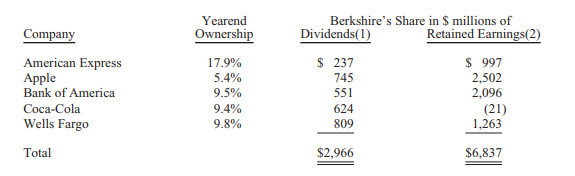
(1) Based on current annual rate. (1) 基於當前年率.
(2) Based on 2018 earnings minus common and preferred dividends paid. (2) 基於2018年盈利扣除普通股和優先股股息的數字

GAAP – which dictates the earnings we report – does not allow us to include the retained earnings of investees in our financial accounts. But those earnings are of enormous value to us: Over the years, earnings retained by our investees (viewed as a group) have eventually delivered capital gains to Berkshire that totaled more than one dollar for each dollar these companies reinvested for us.
我們當前所報告的盈利必須基於GAAP原則,後者不允許我們將投資對象的保留盈利計入我們的財務數據。可是,這些盈利對於我們卻有著巨大的價值——長期而言,作為一個整體,我們投資對象所保留的盈利最終將為波克夏創造出極為可觀的資本利得,今天他們再投資的一美元,未來帶給我們的將遠超過一美元。

All of our major holdings enjoy excellent economics, and most use a portion of their retained earnings to repurchase their shares. We very much like that: If Charlie and I think an investee’s stock is underpriced, we rejoice when management employs some of its earnings to increase Berkshire’s ownership percentage.
從經濟視角看來,我們的所有主要持股都可圈可點,這些企業都在使用自己保留的一部分盈利回購自家的股票。我們非常樂於看到這一幕:如果查理和我覺得投資對象股票的價格被低估了,而管理層又決定動用一部分保留盈利來提升波克夏持股相應的所有權百分比時,我們會開心地慶祝起來的。

Here’s one example drawn from the table above: Berkshire’s holdings of American Express have remained unchanged over the past eight years. Meanwhile, our ownership increased from 12.6% to 17.9% because of repurchases made by the company. Last year, Berkshire’s portion of the $6.9 billion earned by American Express was $1.2 billion, about 96% of the $1.3 billion we paid for our stake in the company. When earnings increase and shares outstanding decrease, owners – over time – usually do well.
下面是從上表中舉出的一個例子:波克夏對美國運通的持股量在過去八年時間裡一直都保持不變。與此同時,由於該公司回購了股票,因此我們的持股比例從12.6%上升到了17.9%。去年,在美國運通賺到的69億美元中,波克夏分到了12億美元,在我們為收購該公司股票而支付的13億美元中佔到了96%左右。當盈利增長且在外流通股票總量減少時,股票持有者——隨著時間的推移——通常會有良好的表現。

A third category of Berkshire’s business ownership is a quartet of companies in which we share control with other parties. Our portion of the after-tax operating earnings of these businesses – 26.7% of Kraft Heinz, 50% of Berkadia and Electric Transmission Texas, and 38.6% of Pilot Flying J – totaled about $1.3 billion in 2018.
波克夏擁有的第三類企業是我們與其他各方共用控制權的四家公司。2018年中,我們在這些企業的稅後營業利潤中所佔份額——卡夫亨氏為26.7%、Berkadia和得州電力傳輸公司均為50%,Pilot Flying J為38.6%——總計約為13億美元。

In our fourth grove, Berkshire held $112 billion at yearend in U.S. Treasury bills and other cash equivalents, and another $20 billion in miscellaneous fixed-income instruments. We consider a portion of that stash to be untouchable, having pledged to always hold at least $20 billion in cash equivalents to guard against external calamities. We have also promised to avoid any activities that could threaten our maintaining that buffer.
第四類則是,截至年底為止波克夏持有價值1120億美元的美國國庫券和其他現金等價物,另有200億美元的雜項固定收益工具。我們認為,這些儲備中有一部分是不可動的,承諾始終會持有至少200億美元的現金等價物以防範外部災難。我們還承諾將避免任何可能威脅到我們維持這種緩衝的活動。

Berkshire will forever remain a financial fortress. In managing, I will make expensive mistakes of commission and will also miss many opportunities, some of which should have been obvious to me. At times, our stock will tumble as investors flee from equities. But I will never risk getting caught short of cash.
波克夏永遠都將保持一個金融堡壘的身份。在管理方面,我會犯代價高昂的委任錯誤,也會錯失許多機會,其中一些機會對我來說原本該是顯而易見的。有些時候,隨著投資者逃離股市,我們的股價會大幅下挫。但我永遠都不會冒現金短缺的風險。

In the years ahead, we hope to move much of our excess liquidity into businesses that Berkshire will permanently own. The immediate prospects for that, however, are not good: Prices are sky-high for businesses possessing decent long-term prospects.
在接下來的幾年裡,我們希望將很大一部分的過剩流動性轉移到波克夏將會永久保有的業務中去。然而,就此而言其近期前景並不好:那些擁有良好長期前景的企業的價格高得離譜。

That disappointing reality means that 2019 will likely see us again expanding our holdings of marketable equities. We continue, nevertheless, to hope for an elephant-sized acquisition. Even at our ages of 88 and 95 – I’m the young one – that prospect is what causes my heart and Charlie’s to beat faster. (Just writing about the possibility of a huge purchase has caused my pulse rate to soar.)
這種令人失望的現實情況意味著,我們很可能會在2019年中再次擴大對有價證券的持有量。儘管如此,我們仍舊希望能夠達成一項“大象”級別的並購交易。儘管我們兩人都已是88歲和95歲高齡——我是兩人當中比較年輕的那個——但這種前景仍舊會讓我和查理心跳加快。(剛寫到進行一筆巨額並購交易的可能性,我的脈搏就飆升了。)

My expectation of more stock purchases is not a market call. Charlie and I have no idea as to how stocks will behave next week or next year. Predictions of that sort have never been a part of our activities. Our thinking, rather, is focused on calculating whether a portion of an attractive business is worth more than its market price.
我的預期是未來將會購買更多的股票,但這並不是市場決定的結果。查理和我對股市下周或明年的走勢毫無概念,這種預測從來都不是我們會從事的活動。相反,我們的想法是專注於計算一家有吸引力的企業的一部分股票是否會比其市場價格更值錢。

************
I believe Berkshire’s intrinsic value can be approximated by summing the values of our four asset-laden groves and then subtracting an appropriate amount for taxes eventually payable on the sale of marketable securities.
我認為,計算波克夏的內在價值的大致方式是,將我們四個豐裕的資產類別的價值加到一起,然後減去出售有價證券所應繳納的稅款的適當金額。

You may ask whether an allowance should not also be made for the major tax costs Berkshire would incur if we were to sell certain of our wholly-owned businesses. Forget that thought: It would be foolish for us to sell any of our wonderful companies even if no tax would be payable on its sale. Truly good businesses are exceptionally hard to find. Selling any you are lucky enough to own makes no sense at all.
你們可能會問,如果我們出售特定的全資企業,那麽波克夏將需承擔的主要稅收成本是否也不該得到稅收抵免。忘記那種想法吧:如果我們賣掉任何一家優秀的公司,那都是很是愚蠢的,即使賣出這些公司並不需要繳稅。真正的好企業是特別難找的,出售任何你足夠幸運才得以擁有的東西是講不通的。

The interest cost on all of our debt has been deducted as an expense in calculating the earnings at Berkshire’s non-insurance businesses. Beyond that, much of our ownership of the first four groves is financed by funds generated from Berkshire’s fifth grove – a collection of exceptional insurance companies. We call those funds “float,” a source of financing that we expect to be cost-free – or maybe even better than that – over time. We will explain the characteristics of float later in this letter.
在計算波克夏非保險業務的收益時,所有債務的利息成本都已被扣除。另外,我們對前四個資產類別的大部分所有權都是由波克夏的第五個資產類別——一批優秀的保險公司——來提供資金的。我們將這些資金稱為“浮存金”,並期望隨著時間的推移,這種資金將是無成本的——或是可能比這更好。我們將在這封信的稍後部分解釋浮存金的特點。
Finally, a point of key and lasting importance: Berkshire’s value is maximized by our having assembled the five groves into a single entity. This arrangement allows us to seamlessly and objectively allocate major amounts of capital, eliminate enterprise risk, avoid insularity, fund assets at exceptionally low cost, occasionally take advantage of tax efficiencies, and minimize overhead
最後,很關鍵而且長久以來都很重要的一點是:通過將五個資產類別合並成一個整體的方式,波克夏的價值被最大化了。這種安排使我們能夠無縫地、客觀地分配大量資本,消除企業風險,避免孤立,以極低的成本為資產提供資金,偶爾利用一下稅收效率,並將管理費用降至最低水準。

At Berkshire, the whole is greater – considerably greater – than the sum of the parts.
在波克夏,整體要大於——是遠遠大於——各個部分的簡單相加。

Repurchases and Reporting
回購和報告


Earlier I mentioned that Berkshire will from time to time be repurchasing its own stock. Assuming that we buy at a discount to Berkshire’s intrinsic value – which certainly will be our intention – repurchases will benefit both those shareholders leaving the company and those who stay
此前我曾提到,波克夏將不時回購自己的股票。假設我們以低於波克夏內在價值的價格購買股票——我們的意圖當然是這樣的——那麽回購對那些離開公司的股東和留下來的股東都將是有利的。

True, the upside from repurchases is very slight for those who are leaving. That’s because careful buying by us will minimize any impact on Berkshire’s stock price. Nevertheless, there is some benefit to sellers in having an extra buyer in the market.
誠然,回購的好處對於那些將要離開的人來說是微乎其微的。這是因為,我們謹慎的回購活動將在最大限度上降低對波克夏股價的任何影響。但對賣家來說,在市場上多出一個買家是有一些好處的。

For continuing shareholders, the advantage is obvious: If the market prices a departing partner’s interest at, say, 90¢ on the dollar, continuing shareholders reap an increase in per-share intrinsic value with every repurchase by the company. Obviously, repurchases should be price-sensitive: Blindly buying an overpriced stock is valuedestructive, a fact lost on many promotional or ever-optimistic CEOs.
對於繼續留下來的股東來說,好處是顯而易見的:比如說,如果市場將離開的合夥人的權益定價為每美元90美分,那麽對繼續留下來的股東來說,每股內在價值就會隨著公司的每一次回購而增長。顯然,回購應該是具有價格敏感性的:盲目購買定價過高的股票對價值具有破壞性,很多做推廣的或是永遠樂觀的首席執行官都漏掉了這個事實。

When a company says that it contemplates repurchases, it’s vital that all shareholder-partners be given the information they need to make an intelligent estimate of value. Providing that information is what Charlie and I try to do in this report. We do not want a partner to sell shares back to the company because he or she has been misled or inadequately informed.
當一家公司稱其打算回購股票時,至關重要的一點是要向所有股東合夥人提供其所需要的資訊,以便他們對價值做出明智的估測,而提供這些資訊是查理和我在這份報告中試圖要做的事情。我們不希望合作夥伴向公司賣回股票,只是因為他/她受到了誤導,或是沒能獲得充足的資訊。

Some sellers, however, may disagree with our calculation of value and others may have found investments that they consider more attractive than Berkshire shares. Some of that second group will be right: There are unquestionably many stocks that will deliver far greater gains than ours.
但是,有些賣家可能不同意我們的價值計算,另一些人則可能已經找到了他們認為比波克夏股票更具吸引力的投資。在第二批人中,有些人將是正確的:毫無疑問,有許多股票都將帶來比我們的股票更大的收益。

In addition, certain shareholders will simply decide it’s time for them or their families to become net consumers rather than continuing to build capital. Charlie and I have no current interest in joining that group. Perhaps we will become big spenders in our old age.
另外,某些股東會簡單地判定,現在已經到了他們或其家人該要成為淨消費者、而不是繼續積累資本的時候。查理和我現在沒有興趣加入那個群體,或許要到我們年老的時候,才會成為大手大腳的人吧。

************
For 54 years our managerial decisions at Berkshire have been made from the viewpoint of the shareholders who are staying, not those who are leaving. Consequently, Charlie and I have never focused on current-quarter results.
54年以來,我們在波克夏作出的管理決策一直都是從留下來的股東、而不是那些離開的股東的角度出發的。因此,查理和我從來都不會把關注的重點放在本季度的業績上。

Berkshire, in fact, may be the only company in the Fortune 500 that does not prepare monthly earnings reports or balance sheets. I, of course, regularly view the monthly financial reports of most subsidiaries. But Charlie and I learn of Berkshire’s overall earnings and financial position only on a quarterly basis.
事實上,波克夏可能是《財富》雜誌500強中唯一不編制月度盈利報告或資產負債表的公司。當然,我經常都會查看多數子公司的月度財務報告。但對於波克夏的總體收益和財務狀況,查理和我只會通過季度報告來加以瞭解。

Furthermore, Berkshire has no company-wide budget (though many of our subsidiaries find one useful). Our lack of such an instrument means that the parent company has never had a quarterly “number” to hit. Shunning the use of this bogey sends an important message to our many managers, reinforcing the culture we prize.
此外,波克夏不會針對整個公司制定預算(但許多子公司都發現制定預算是有用的)。我們缺少這樣的工具,這就意味著母公司從來都沒有一個季度“數字”需要去實現。避免制定這種令人恐懼的目標向我們的許多經理人傳遞了一個重要的資訊,加強了我們所珍視的文化。

Over the years, Charlie and I have seen all sorts of bad corporate behavior, both accounting and operational, induced by the desire of management to meet Wall Street expectations. What starts as an “innocent” fudge in order to not disappoint “the Street” – say, trade-loading at quarter-end, turning a blind eye to rising insurance losses, or drawing down a “cookie-jar” reserve – can become the first step toward full-fledged fraud. Playing with the numbers “just this once” may well be the CEO’s intent; it’s seldom the end result. And if it’s okay for the boss to cheat a little, it’s easy for subordinates to rationalize similar behavior.

多年以來,查理和我已經看到了各式各樣的不良企業行為——有會計方面的,也有運營方面的——都是由於管理層希望達到華爾街預期而引發的。為了不讓“華爾街”失望,有些公司最初原本只是想要“無害”地弄虛作假——比如說,在季度末時超載交易,對保險損失的成本視而不見,或是掏空“餅乾罐”儲備等——但這可能會成為全面欺詐的第一步。首席執行官的意圖可能是“僅此一次”給數據注水,但最終的結果少有與其最初意圖相符的。如果說高層小小作弊是無傷大雅的,那麽下屬就很容易將類似的行為合理化。

At Berkshire, our audience is neither analysts nor commentators: Charlie and I are working for our shareholder-partners. The numbers that flow up to us will be the ones we send on to you.
在波克夏,我們的閱聽人既不是分析師,也不是評論人士:查理和我是效命於我們的股東合作夥伴的。我們從下屬那裡獲得的數據,就是我們發給你們的數據。

Non-Insurance Operations – From Lollipops to Locomotives
非保險業務 - 從棒棒糖到機車


Let’s now look further at Berkshire’s most valuable grove – our collection of non-insurance businesses – keeping in mind that we do not wish to unnecessarily hand our competitors information that might be useful to them. Additional details about individual operations can be found on pages K-5 – K-22 and pages K-40 – K-51. 
現在讓我們進一步了解一下波克夏最有價值的樹林 - 我們非保險業務的集合 - 請記住,我們不希望向競爭對手提供可能對他們有用的信息。有關各個業務的更多詳細信息,請參見第K-5至K-22頁和K-40至K-51頁。
Viewed as a group, these businesses earned pre-tax income in 2018 of $20.8 billion, a 24% increase over 2017. Acquisitions we made in 2018 delivered only a trivial amount of that gain.
作為一個集團,這些企業在2018年的稅前淨利潤為208億美元,比2017年增長24%。我們在2018年的收購隻帶來了微不足道的收益。

I will stick with pre-tax figures in this discussion. But our after-tax gain in 2018 from these businesses was far greater – 47% – thanks in large part to the cut in the corporate tax rate that became effective at the beginning of that year. Let’s look at why the impact was so dramatic.
在此的討論中,我會堅持用稅前數字。 但是,我們2018年從這些業務中獲得的稅後收益的漲幅要遠高於稅前,高達47% - 這在很大程度上要歸功於年初生效的公司稅率消減。讓我們來看看為什麽影響如此戲劇性。

Begin with an economic reality: Like it or not, the U.S. Government “owns” an interest in Berkshire’s earnings of a size determined by Congress. In effect, our country’s Treasury Department holds a special class of our stock – call this holding the AA shares – that receives large “dividends” (that is, tax payments) from Berkshire. In 2017, as in many years before, the corporate tax rate was 35%, which meant that the Treasury was doing very well with its AA shares. Indeed, the Treasury’s “stock,” which was paying nothing when we took over in 1965, had evolved into a holding that delivered billions of dollars annually to the federal government. 從經濟現實開始:無論喜歡與否,美國政府“擁有”伯克希爾的一部分權益,其比例由國會決定。 實際上,我們國家的財政部持有我們一種特殊類別的股票 - 稱之為持有AA股票 - 並從伯克希爾獲得大量“股息”(即稅收)。 2017年,與多年前一樣,企業稅率為35%,這意味著財政部的AA股表現非常好。 事實上,財政部在我們1965年接手伯克希爾時沒有支付任何費用的“股票”,在過去幾十年裡已經發展成為每年向聯邦政府提供數十億美元的控股權。

Last year, however, 40% of the government’s “ownership” (14/35ths) was returned to Berkshire – free of charge – when the corporate tax rate was reduced to 21%. Consequently, our “A” and “B” shareholders received a major boost in the earnings attributable to their shares.
然而,去年,當公司稅率降至21%時,40%的政府“所有權”(14/35)被免費退還給伯克希爾。 因此,我們的“A”和“B”股東的股票收益大幅增加。

This happening materially increased the intrinsic value of the Berkshire shares you and I own. The same dynamic, moreover, enhanced the intrinsic value of almost all of the stocks Berkshire holds.
這種情況實質上增加了你和我擁有的波克夏股票的內在價值。此外,同樣的因素還增加了伯克希爾幾乎所有持股的內在價值。
Those are the headlines. But there are other factors to consider that tempered our gain. For example, the tax benefits garnered by our large utility operation get passed along to its customers. Meanwhile, the tax rate applicable to the substantial dividends we receive from domestic corporations is little changed at about 13%. (This lower rate has long been logical because our investees have already paid tax on the earnings that they pay to us.) Overall, however, the new law made our businesses and the stocks we own considerably more valuable.
這些是關鍵因素。但還有其他一些因素使得我們的收益受到不利影響。例如,我們的大型公用事業運營所帶來的稅收優惠需要傳遞給客戶。同時,適用於我們從國內公司獲得的大量股息的稅率幾乎沒有變化,約為13%。 (這種較低的利率一直是合乎邏輯的,因為我們的被投資者已經為他們向我們支付股息的利潤交過稅了。)但總的來說,新法律使我們的業務和我們擁有的股票更有價值。

Which suggests that we return to the performance of our non-insurance businesses. Our two towering redwoods in this grove are BNSF and Berkshire Hathaway Energy (90.9% owned). Combined, they earned $9.3 billion before tax last year, up 6% from 2017. You can read more about these businesses on pages K-5 – K-10 and pages K-40 – K-45.
這表明我們恢復了非保險業務的表現。我們在這個樹林裡的兩個高聳的紅杉是BNSF和Berkshire Hathaway Energy(擁有90.9%)。合並之後,他們去年的稅前利潤為93億美元,比2017年增長了6%。您可以在K-5-K-10頁和K-40-K-45頁上閱讀更多關於這些業務的信息。

Our next five non-insurance subsidiaries, as ranked by earnings (but presented here alphabetically), Clayton Homes, International Metalworking, Lubrizol, Marmon and Precision Castparts, had aggregate pre-tax income in 2018 of $6.4 billion, up from the $5.5 billion these companies earned in 2017.
我們接下來的按收益排名靠前的五家非保險子公司(這裡按字母順序排列)分別為:Clayton Homes,International Metalworking,Lubrizol,Marmon和Precision Castparts,他們在2018年的稅前利潤總額為64億美元,高於在2017年獲得的55億美元。

The next five, similarly ranked and listed (Forest River, Johns Manville, MiTek, Shaw and TTI) earned $2.4 billion pre-tax last year, up from $2.1 billion in 2017.
再接下來的五家公司(Forest River,Johns Manville,MiTek,Shaw和TTI)去年的稅前利潤為24億美元,高於2017年的21億美元。

The remaining non-insurance businesses that Berkshire owns – and there are many – had pre-tax income of $3.6 billion in 2018 vs. $3.3 billion in 2017.
波克夏擁有的剩餘非保險業務 - 有許多 - 在2018年的稅前利潤為36億美元,而2017年為33億美元。

Insurance, “Float,” and the Funding of Berkshire
保險,“浮存金“和波克夏的資金


Our property/casualty (“P/C”) insurance business – our fifth grove – has been the engine propelling Berkshire’s growth since 1967, the year we acquired National Indemnity and its sister company, National Fire & Marine, for $8.6 million. Today, National Indemnity is the largest property/casualty company in the world as measured by net worth.
1967年以來,財產/意外險(P / C)業務 – 第五大收益來源 – 一直是波克夏業績增長的引擎。1967年,波克夏以860萬美元收購了國民保險公司(National Indemnity)及其姊妹公司國民火災及海事保險公司(National Fire&Marine)。如今,以淨資產衡量,國民保險公司是世界上最大的財產/意外險公司。

One reason we were attracted to the P/C business was the industry’s business model: P/C insurers receive premiums upfront and pay claims later. In extreme cases, such as claims arising from exposure to asbestos, or severe workplace accidents, payments can stretch over many decades.
我們被P / C業務吸引的原因之一是該行業的商業模式:P / C保險公司先收取保費後賠付。在極端情況下,一些理賠(如接觸石棉,或嚴重的工作場所事故)的賠付可能持續數十年。

This collect-now, pay-later model leaves P/C companies holding large sums – money we call “float” – that will eventually go to others. Meanwhile, insurers get to invest this float for their own benefit. Though individual policies and claims come and go, the amount of float an insurer holds usually remains fairly stable in relation to premium volume. Consequently, as our business grows, so does our float. And how it has grown, as the following table shows:
這種“先收取保費,後賠付”的模式讓P / C公司持有大筆資金 - 我們稱之為“浮存金” - 最終會賠付給其他人。與此同時,保險公司會將這筆浮存金拿去投資獲利。雖然個人的保單和理賠來來去去,但保險公司持有的保費收入相關的浮存金一般較為穩定。因此,隨著保險業務的增長,浮存金也隨之增長。下表所示為浮存金的具體增長情況:
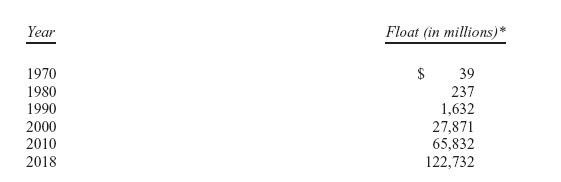
* Includes float arising from life, annuity and health insurance businesses.
* 包括人壽、年金和健康保險業務獲得的浮存金。

We may in time experience a decline in float. If so, the decline will be very gradual – at the outside no more than 3% in any year. The nature of our insurance contracts is such that we can never be subject to immediate or nearterm demands for sums that are of significance to our cash resources. That structure is by design and is a key component in the unequaled financial strength of our insurance companies. That strength will never be compromised.
我們偶爾也會遇到浮存金回落。如果浮存出現下滑,下滑幅度將是非常緩慢的 - 單一年度最多不超過3%。我們的保險合約的性質使我們永遠不會受到對我們現金資源具有重要意義的金額的即時或近期需求。這種結構是精心設計的,是我們保險公司無與倫比的財力的關鍵組成部分。這方面能力的絕不會妥協。

If our premiums exceed the total of our expenses and eventual losses, our insurance operation registers an underwriting profit that adds to the investment income the float produces. When such a profit is earned, we enjoy the use of free money – and, better yet, get paid for holding it.
如果保費超過我們的支出和最終損失,我們的保險業務會獲得承保利潤,進一步增加浮存的投資收益。獲得承保利潤時,我們有自由資金可用 - 而且,更好的是,通過持有這筆資金獲得回報。

Unfortunately, the wish of all insurers to achieve this happy result creates intense competition, so vigorous indeed that it sometimes causes the P/C industry as a whole to operate at a significant underwriting loss. That loss, in effect, is what the industry pays to hold its float. Competitive dynamics almost guarantee that the insurance industry, despite the float income all its companies enjoy, will continue its dismal record of earning subnormal returns on tangible net worth as compared to other American businesses.
不幸的是,所有保險公司都希望實現這一圓滿結果,進而導致競爭激烈,以至於整個P / C行業處於嚴重的承保虧損狀態。實際上,這種損失是整個行業為持有浮存而付出的代價。儘管所有公司都能享有浮存收益,與美國的其他行業相比,持續的競爭幾乎鐵定讓保險行業繼續面臨有形淨資產收益低於正常水準的慘淡記錄。

Nevertheless, I like our own prospects. Berkshire’s unrivaled financial strength allows us far more flexibility in investing our float than that generally available to P/C companies. The many alternatives available to us are always an advantage and occasionally offer major opportunities. When other insurers are constrained, our choices expand.
不過,我看好波克夏的前景。波克夏擁有無與倫比的財力,這使得我們在投資浮存方面相比其他P / C公司更具靈活性。我們擁有許多選擇始終是一個優勢,這些選擇時不時會帶來重大機遇。當其他保險公司受困,我們的選擇就多了。

Moreover, our P/C companies have an excellent underwriting record. Berkshire has now operated at an underwriting profit for 15 of the past 16 years, the exception being 2017, when our pre-tax loss was $3.2 billion. For the entire 16-year span, our pre-tax gain totaled $27 billion, of which $2 billion was recorded in 2018.
此外,波克夏的P / C公司擁有良好的承保記錄。過去的16年裡,其中15年波克夏都獲得了承保利潤,唯一例外的是2017年,這一年我們的稅前虧損達32億美元。在16年的時間裡,我們的稅前收益總計270億美元,其中去年(2018年)的收益達20億美元。

That record is no accident: Disciplined risk evaluation is the daily focus of our insurance managers, who know that the benefits of float can be drowned by poor underwriting results. All insurers give that message lip service. At Berkshire it is a religion, Old Testament style.
數據記錄並非偶然:嚴格的風險評估是我們的保險經理每天的工作重點,他們深知浮動資金的好處可以抵消不良承保業績。所有保險公司都是給口頭消息。而在波克夏·海瑟威公司,則是一種宗教類似的嚴謹風格。

************
In most cases, the funding of a business comes from two sources – debt and equity. At Berkshire, we have two additional arrows in the quiver to talk about, but let’s first address the conventional components.
在大多數情況下,企業的資金來自兩個來源——債券和股票。在波克夏·海瑟威公司,我們有兩個額外的關鍵值得談論,但讓我們先談談傳統的組成部分。

We use debt sparingly. Many managers, it should be noted, will disagree with this policy, arguing that significant debt juices the returns for equity owners. And these more venturesome CEOs will be right most of the time.
我們對債務非常謹慎。應該注意到的是,很多經理可能不同意這一觀點,認為大量的債務會使股東的回報更加豐厚。而在大多數情況下,這些善於冒險的首席執行官將被證明在多數情況下是正確的。

At rare and unpredictable intervals, however, credit vanishes and debt becomes financially fatal. A Russianroulette equation – usually win, occasionally die – may make financial sense for someone who gets a piece of a company’s upside but does not share in its downside. But that strategy would be madness for Berkshire. Rational people don’t risk what they have and need for what they don’t have and don’t need.
然而,在罕見且不可預測的時間間隔內,信貸消失,債務在財務上變得致命。俄羅斯的輪盤賭等式——通常是贏,偶爾是輸——對於那些從一家公司的上漲中分得一杯羹,但不分享其下跌的人來說,可能具有財務意義。但這種策略對波克夏來說是瘋狂的。理性的人不會拿他們擁有和需要的東西去冒險,去換取他們沒有和不需要的東西。
Most of the debt you see on our consolidated balance sheet – see page K-65 – resides at our railroad and energy subsidiaries, both of them asset-heavy companies. During recessions, the cash generation of these businesses remains bountiful. The debt they use is both appropriate for their operations and not guaranteed by Berkshire.
你們在我們的綜合資產負債表上看到的大部分債務——見K65頁——存在於我們的鐵路和能源子公司,都是重資產型的公司。在經濟衰退期間,這些企業產生的現金流仍然充裕。他們使用的債務既適用於他們的業務,也不受波克夏的擔保。

Our level of equity capital is a different story: Berkshire’s $349 billion is unmatched in corporate America. By retaining all earnings for a very long time, and allowing compound interest to work its magic, we have amassed funds that have enabled us to purchase and develop the valuable groves earlier described. Had we instead followed a 100% payout policy, we would still be working with the $22 million with which we began fiscal 1965.
我們的股本水準則是另一回事:波克夏·海瑟威公司持有的3,490億美元在美國企業界來說是無與倫比的。通過將所有收益長期保留,並允許複利發揮其作用,積累的資金使我們能夠購買和發展前面描述的寶貴的各項業務。如果我們還遵循100%的支付政策,我們仍將只有1965財年開始使用的2200萬美元。
Beyond using debt and equity, Berkshire has benefitted in a major way from two less-common sources of corporate funding. The larger is the float I have described. So far, those funds, though they are recorded as a huge net liability on our balance sheet, have been of more utility to us than an equivalent amount of equity. That’s because they have usually been accompanied by underwriting earnings. In effect, we have been paid in most years for holding and using other people’s money.
除了使用債務和股本,波克夏·海瑟威公司主要受益於兩種不太常見的企業融資來源。佔比較大的是我所描述的浮動資金。到目前為止,這些資金,儘管它們在我們的資產負債表上被記錄為巨大的淨負債,但他們產生的功效已經超過了同等數量的資金數額所起的作用。這是因為它們通常伴隨著承銷收益。實際上, 多年來,我們一直因為持有和使用所謂的他人的資金而得到報酬。

As I have often done before, I will emphasize that this happy outcome is far from a sure thing: Mistakes in assessing insurance risks can be huge and can take many years to surface. (Think asbestos.) A major catastrophe that will dwarf hurricanes Katrina and Michael will occur – perhaps tomorrow, perhaps many decades from now. “The Big One” may come from a traditional source, such as a hurricane or earthquake, or it may be a total surprise involving, say, a cyber attack having disastrous consequences beyond anything insurers now contemplate. When such a megacatastrophe strikes, we will get our share of the losses and they will be big – very big. Unlike many other insurers, however, we will be looking to add business the next day.
就如我之前做過的,我要強調的是,這一令人高興的結果遠非確定無疑:在評估保險風險方面的錯誤可能是巨大的,可能需要多年之後才能浮出水面。一場將使卡特裡娜颶風和邁克爾颶風相形見絀的大災可能在明天發生,也可能在十年之後發生。“大地震”可能是說傳統意義上額災難,如颶風或地震,或者,它可能完全出乎意料,比如,網絡攻擊造成的災難性後果超出了保險公司目前的預期。當這樣的大災難發生時,我們將分擔損失,而且損失將是巨大的——非常大的。然而,與許多其它保險公司不同的是,我們將在第二天尋求增加業務。

The final funding source – which again Berkshire possesses to an unusual degree – is deferred income taxes. These are liabilities that we will eventually pay but that are meanwhile interest-free.
另一個資金來源——波克夏·海瑟威公司擁有一個不同尋常的優勢——遞延所得稅。這些都是負債,我們最終將支付但無需支付利息。

As I indicated earlier, about $14.7 billion of our $50.5 billion of deferred taxes arises from the unrealized gains in our equity holdings. These liabilities are accrued in our financial statements at the current 21% corporate tax rate but will be paid at the rates prevailing when our investments are sold. Between now and then, we in effect have an interest-free “loan” that allows us to have more money working for us in equities than would otherwise be the case.
像我剛才說的,大約505億美元中的147億美元的的遞延稅收來自股票的未實現收益。這些負債在我們的財務報表中按當前21%的公司稅稅率計算,但將按我們的投資出售時的現行稅率支付。從現在到那時,我們實際上擁有了一筆無息“貸款”,這讓我們能夠有更多的資金為股票投資。

A further $28.3 billion of deferred tax results from our being able to accelerate the depreciation of assets such as plant and equipment in calculating the tax we must currently pay. The front-ended savings in taxes that we record gradually reverse in future years. We regularly purchase additional assets, however. As long as the present tax law prevails, this source of funding should trend upward.
此外,由於我們在計算我們必須繳納的稅款時加速折舊了廠房和設備等資產,因此我們還需要繳納283億美元的遞延所得稅。我們所記錄的前期稅收節省將在未來幾年逐漸好轉。然而,我們還經常購買額外的資產。只要現行稅法持續生效,這一資金來源就應呈上升趨勢。
Over time, Berkshire’s funding base – that’s the right-hand side of our balance sheet – should grow, primarily through the earnings we retain. Our job is to put the money retained to good use on the left-hand side, by adding attractive assets.
隨著時間的推移,波克夏的資金(資產負債表的右側一欄)應該會增長,這主要是通過我們所保留的收益來實現的。我們需要通過增加有吸引力的資產,把留存下來的錢很好地用在資產負債表的左側一欄。
GEICO and Tony Nicely
GEICO和托尼-奈斯利(Tony Nicely)


That title says it all: The company and the man are inseparable.
這個標題說明瞭一切:公司的發展和奈斯利是密不可分的。

Tony joined GEICO in 1961 at the age of 18; I met him in the mid-1970s. At that time, GEICO, after a fourdecade record of both rapid growth and outstanding underwriting results, suddenly found itself near bankruptcy. A recently-installed management had grossly underestimated GEICO’s loss costs and consequently underpriced its product. It would take many months until those loss-generating policies on GEICO’s books – there were no less than 2.3 million of them – would expire and could then be repriced. The company’s net worth in the meantime was rapidly approaching zero.
1961年,18歲的托尼加入了GEICO。我在70年代中期見過他。當時,GEICO在經歷了40年的快速增長和出色的承銷業績後,突然發現自己瀕臨破產。該公司最近上任的管理層嚴重低估了GEICO的損失成本,因此低估了其產品的價格。GEICO帳簿上那些產生虧損的保單(數量不少於230萬份)還有好幾個月的時間才能到期,然後才能被重新定價。與此同時,該公司的淨值正迅速趨零。

In 1976, Jack Byrne was brought in as CEO to rescue GEICO. Soon after his arrival, I met him, concluded that he was the perfect man for the job, and began to aggressively buy GEICO shares. Within a few months, Berkshire bought about 1⁄3 of the company, a portion that later grew to roughly 1⁄2 without our spending a dime. That stunning accretion occurred because GEICO, after recovering its health, consistently repurchased its shares. All told, this halfinterest in GEICO cost Berkshire $47 million, about what you might pay today for a trophy apartment in New York.
1976年,傑克-伯恩(Jack Byrne)被任命為首席執行官來拯救GEICO。他上任後不久,我就見到了他。我認為他是這個職位的最佳人選,並開始積極買進GEICO的股票。在幾個月內,波克夏公司購買了該公司約三分之一的股份,後來在沒有增加一分錢投資的情況下,這些資產擴大到了該公司股票份額的二分之一。這種驚人的增長之所以發生,是因為GEICO在恢復健康後,一直在回購股票。總的來說,波克夏花了隻4700萬美元就買下了GEICO二分之一的資產,相當於你今天在紐約買一套豪華公寓的價格。

Let’s now fast-forward 17 years to 1993, when Tony Nicely was promoted to CEO. At that point, GEICO’s reputation and profitability had been restored – but not its growth. Indeed, at yearend 1992 the company had only 1.9 million auto policies on its books, far less than its pre-crisis high. In sales volume among U.S. auto insurers, GEICO then ranked an undistinguished seventh.
現在讓我們回到17年前的1993年,托尼-奈斯利被提升為GEICO的首席執行官(CEO)。那時,GEICO的聲譽和盈利能力得到了恢復,但增長卻沒有恢復。事實上,到1992年底,該公司的汽車保單只有190萬份,遠低於危機前的最高水準。在美國汽車保險公司的銷售量中,GEICO排名第七。

Late in 1995, after Tony had re-energized GEICO, Berkshire made an offer to buy the remaining 50% of the company for $2.3 billion, about 50 times what we had paid for the first half (and people say I never pay up!). Our offer was successful and brought Berkshire a wonderful, but underdeveloped, company and an equally wonderful CEO, who would move GEICO forward beyond my dreams.
1995年末,在托尼重新給GEICO注入活力之後,波克夏提出以23億美元收購GEICO剩餘50%的股份,這大約是我們收購該公司前一半資產價格的50倍(而且人們總說我不會在高位購買資產)。我們的收購獲得了成功,這為波克夏帶來了一家出色且還有發展潛力的公司,以及一位同樣出色的CEO,他讓GEICO的發展超越了我的期望。

GEICO is now America’s Number Two auto insurer, with sales 1,200% greater than it recorded in 1995. Underwriting profits have totaled $15.5 billion (pre-tax) since our purchase, and float available for investment has grown from $2.5 billion to $22.1 billion.
GEICO現在是美國第二大汽車保險公司,銷售額比1995年增長了1200%。自收購以來,該公司的承銷利潤總計為155億美元(稅前),可供投資的流通股市值已從25億美元增至221億美元。

By my estimate, Tony’s management of GEICO has increased Berkshire’s intrinsic value by more than $50 billion. On top of that, he is a model for everything a manager should be, helping his 40,000 associates to identify and polish abilities they didn’t realize they possessed.
據我估計,托尼對GEICO的管理使波克夏的內在價值增加了500多億美元。最重要的是,他是一個管理者的榜樣,他幫助他的4萬名員工發現並發展了自己一直沒有意識到的能力。

Last year, Tony decided to retire as CEO, and on June 30th he turned that position over to Bill Roberts, his long-time partner. I’ve known and watched Bill operate for several decades, and once again Tony made the right move. Tony remains Chairman and will be helpful to GEICO for the rest of his life. He’s incapable of doing less.
去年,托尼決定辭去CEO一職,6月30日,他把這個職位交給了他的長期合作夥伴比爾-羅伯茨(Bill Roberts)。我認識比爾並看著他工作了幾十年,托尼再一次做出了正確的決定。托尼仍然是GEICO的董事長,他的餘生都將是GEICO的得力助手。他不能撒手不管。

All Berkshire shareholders owe Tony their thanks. I head the list.
波克夏的所有股東都應該感謝托尼,尤其是我。

Investments
投資


Below we list our fifteen common stock investments that at yearend had the largest market value. We exclude our Kraft Heinz holding – 325,442,152 shares – because Berkshire is part of a control group and therefore must account for this investment on the “equity” method. On its balance sheet, Berkshire carries its Kraft Heinz holding at a GAAP figure of $13.8 billion, an amount reduced by our share of the large write-off of intangible assets taken by Kraft Heinz in 2018. At yearend, our Kraft Heinz holding had a market value of $14 billion and a cost basis of $9.8 billion.
以下所列出的是截至去年年底我們所持市值最大的前15隻普通股。我們在此排除了卡夫亨氏的持股(325442152股),因為波克夏本身也是一家控股集團,因此必須用“股權”的方法來解釋這筆投資。在波克夏的資產負債表上,我們所持卡夫亨氏的股份按通用會計準則計算為138億美元,這一數字與我們在2018年卡夫亨氏大規模衝銷無形資產時所佔該公司的份額相比有所減少。到去年年底,我們在卡夫亨氏的持股市值為140億美元,成本為98億美元。


* Excludes shares held by pension funds of Berkshire subsidiaries.
* 不包括伯克希爾子公司養老基金持有的股份。
** This is our actual purchase price and also our tax basis.
**這是我們的實際購買價格以及我們的稅基。

Charlie and I do not view the $172.8 billion detailed above as a collection of ticker symbols – a financial dalliance to be terminated because of downgrades by “the Street,” expected Federal Reserve actions, possible political developments, forecasts by economists or whatever else might be the subject du jour.
查理和我都沒有把以上這些股票(總計持股市值1728億美元)當作是精心收集的潛力股。當前這場金融鬧劇將要結束,因為“華爾街”的降級、美聯儲可能採取的行動、可能出現的政治動向、經濟學家的預測,或者其他任何可能成為當前熱門話題的東西,都將終止這場鬧劇。

What we see in our holdings, rather, is an assembly of companies that we partly own and that, on a weighted basis, are earning about 20% on the net tangible equity capital required to run their businesses. These companies, also, earn their profits without employing excessive levels of debt.
相反,我們把這些公司看作是一個我們進行部分持股的集合,而按加權計算,這些公司運營業務所需的有形淨資產淨利約為20%。這些公司也不需要過度舉債就能獲得利潤。

Returns of that order by large, established and understandable businesses are remarkable under any circumstances. They are truly mind-blowing when compared against the return that many investors have accepted on bonds over the last decade – 3% or less on 30-year U.S. Treasury bonds, for example.
在任何情況下,那些規模巨大、成熟且易於理解的企業的訂單回報率都引人矚目。與很多投資者在過去十年接受的債券回報率(比如,30年期美國國債的收益率是3%或更低)相比,其回報率確實令人振奮。

On occasion, a ridiculously-high purchase price for a given stock will cause a splendid business to become a poor investment – if not permanently, at least for a painfully long period. Over time, however, investment performance converges with business performance. And, as I will next spell out, the record of American business has been extraordinary.
有時候,對某隻股票以過高的價格買入會讓一家卓越的企業變成一次糟糕的投資,就算不是永久性的,至少也要痛苦很長一段時間。然而,隨著時間的推移,投資業績與企業業績趨於一致。並且,正如我接下來要闡述的,美國的商業記錄非同尋常。

The American Tailwind
美國經濟的順風車

On March 11th, it will be 77 years since I first invested in an American business. The year was 1942, I was 11, and I went all in, investing $114.75 I had begun accumulating at age six. What I bought was three shares of Cities Service preferred stock. I had become a capitalist, and it felt good.
3月11日將是我第一次投資美國企業的77周年紀念日。1942年,我11歲,我傾盡所有投資114.75美元,這是我從六歲開始積累的資金。我買的是三股城市服務公司(Cities Service)的優先股。我成了一個資本家,感覺很不錯。

Let’s now travel back through the two 77-year periods that preceded my purchase. That leaves us starting in 1788, a year prior to George Washington’s installation as our first president. Could anyone then have imagined what their new country would accomplish in only three 77-year lifetimes?
現在,讓我們回到我購買股票之前的兩個77年的時期。這讓我們從1788年開始,也就是喬治-華盛頓(George Washington)就任美國第一任總統的前一年。那個時候,誰能想像得到他們的新國家會在短短三個77年的歷程中取得什麽樣的成就?

During the two 77-year periods prior to 1942, the United States had grown from four million people – about 1⁄2 of 1% of the world’s population – into the most powerful country on earth. In that spring of 1942, though, it faced a crisis: The U.S. and its allies were suffering heavy losses in a war that we had entered only three months earlier. Bad news arrived daily
在1942年之前的兩個77年的時間裡,美國從一個四百萬人口(約佔全世界人口的0.5%)的國家發展起來,一舉成為全世界最強大的國家。但是,在1942年春,美國面臨了一次危機:美國及其盟國在僅僅三個月前的戰爭中遭受了巨大損失。每天都傳來壞消息。

Despite the alarming headlines, almost all Americans believed on that March 11th that the war would be won. Nor was their optimism limited to that victory. Leaving aside congenital pessimists, Americans believed that their children and generations beyond would live far better lives than they themselves had led.
儘管新聞頭條讓人憂心忡忡,但幾乎所有美國人都堅信在3月11日戰爭將會取得勝利。他們的樂觀態度並不局限於那一次勝利。撇開天生的悲觀主義不談,美國人認為,他們的子女和後代會過上比他們好得多的生活。

The nation’s citizens understood, of course, that the road ahead would not be a smooth ride. It never had been. Early in its history our country was tested by a Civil War that killed 4% of all American males and led President Lincoln to openly ponder whether “a nation so conceived and so dedicated could long endure.” In the 1930s, America suffered through the Great Depression, a punishing period of massive unemployment.
當然,美國民眾知道,未來的路並非一帆風順。從來沒有一帆風順。在建國初期,我們的國家經受了一場內戰的考驗,這場內戰導致4%的美國男性死亡,林肯總統因此公開思考“這樣一個孕育於自由和奉行自由的國家能否長久存在。”在20世紀30年代,美國經歷了大蕭條,一段大規模失業的懲罰性時期。

Nevertheless, in 1942, when I made my purchase, the nation expected post-war growth, a belief that proved to be well-founded. In fact, the nation’s achievements can best be described as breathtaking.
儘管如此,1942年,當我買入股票的時候,國家期望戰後經濟增長,這一信念被證明理由充分。實際上,美國取得的成就可以說是驚人的。

Let’s put numbers to that claim: If my $114.75 had been invested in a no-fee S&P 500 index fund, and all dividends had been reinvested, my stake would have grown to be worth (pre-taxes) $606,811 on January 31, 2019 (the latest data available before the printing of this letter). That is a gain of 5,288 for 1. Meanwhile, a $1 million investment by a tax-free institution of that time – say, a pension fund or college endowment – would have grown to about $5.3 billion.
讓我們拿數字來說話:如果我的114.75美元投資於一個免費的標普500指數基金,並且所有股息進行再投資, 2019年1月31日我的股票價值會增長到(稅前)606,811美元(這封信出版前的最新可得數據)。獲利是5,288倍。同時,當時的一家免稅機構(比方說,養老金基金或大學捐贈基金)的100萬美元投資會增長到約53億美元。

Let me add one additional calculation that I believe will shock you: If that hypothetical institution had paid only 1% of assets annually to various “helpers,” such as investment managers and consultants, its gain would have been cut in half, to $2.65 billion. That’s what happens over 77 years when the 11.8% annual return actually achieved by the S&P 500 is recalculated at a 10.8% rate.
讓我再增加一個我認為會讓你大吃一驚的計算:如果這個假想的機構每年隻向各種“幫助者”支付1%的資產,如投資經理和顧問,那麽其收益會減半,為26.5億美元。當標普500指數實際實現11.8%的年回報率,在按照10.8%的回報率重新計算時,在77年的時間裡就會出現這種情況。

Those who regularly preach doom because of government budget deficits (as I regularly did myself for many years) might note that our country’s national debt has increased roughly 400-fold during the last of my 77-year periods. That’s 40,000%! Suppose you had foreseen this increase and panicked at the prospect of runaway deficits and a worthless currency. To “protect” yourself, you might have eschewed stocks and opted instead to buy 31⁄4 ounces of gold with your $114.75.
那些因政府預算赤字而經常看空美國經濟的人(正如我多年來經常做的那樣)可能會注意到,在我77年職業生涯的最後階段,我國的國債增加了大約400倍。那可是40,000%!假設你已經預見到這種增長,並對失控的赤字和無價值的貨幣前景感到恐慌。為了“保護”自己,你可能已經避開了股票,而是選擇以114.75美元的價格購買31/4盎司的黃金。

And what would that supposed protection have delivered? You would now have an asset worth about $4,200, less than 1% of what would have been realized from a simple unmanaged investment in American business. The magical metal was no match for the American mettle.
但這個保護措施能夠為你帶來什麽呢?假設你現在擁有的資產價值約為4,200美元,採取這種保護性的投資方式所獲得的收益,還不到美國商業中最簡單的非管理投資所能實現資產收益的1%。儘管黃金是一種神奇的金屬,但顯然在資本回報率方面它配不上美國的勇氣。

Our country’s almost unbelievable prosperity has been gained in a bipartisan manner. Since 1942, we have had seven Republican presidents and seven Democrats. In the years they served, the country contended at various times with a long period of viral inflation, a 21% prime rate, several controversial and costly wars, the resignation of a president, a pervasive collapse in home values, a paralyzing financial panic and a host of other problems. All engendered scary headlines; all are now history.
我們國家以兩黨製的方式取得了幾乎令人難以置信的繁榮。自1942年以來,我們共有七位共和黨總統和七位民主黨總統。在這些年裡,美國在不同時期經歷了長期的病毒式通貨膨脹,21%的優惠利率,幾次有爭議以及代價高昂的戰爭,總統辭職,房地產市場崩潰,金融危機癱瘓和許多其他問題。每一個都是一條可怕的頭條新聞;但現在這些已經都成為了歷史。

Christopher Wren, architect of St. Paul’s Cathedral, lies buried within that London church. Near his tomb are posted these words of description (translated from Latin): “If you would seek my monument, look around you.” Those skeptical of America’s economic playbook should heed his message.
聖保羅大教堂的建築師克里斯多夫-雷恩(Christopher Wren)被埋葬在倫敦教堂內。在他的墳墓附近張貼著這些描述性的詞語(翻譯自拉丁語):“如果你想尋找我的紀念碑,請環顧四周。”那些對美國經濟劇本持懷疑態度的人應該留意他的這段話。

In 1788 – to go back to our starting point – there really wasn’t much here except for a small band of ambitious people and an embryonic governing framework aimed at turning their dreams into reality. Today, the Federal Reserve estimates our household wealth at $108 trillion, an amount almost impossible to comprehend.
時間退回到1788年,這是我們的起點,除了一小群雄心勃勃的人和一個旨在將夢想變為現實的管理框架雛形之外,這裡確實什麽都沒有。到今天,美聯儲估計我們的家庭財富為108兆美元,幾乎無法想像。

Remember, earlier in this letter, how I described retained earnings as having been the key to Berkshire’s prosperity? So it has been with America. In the nation’s accounting, the comparable item is labeled “savings.” And save we have. If our forefathers had instead consumed all they produced, there would have been no investment, no productivity gains and no leap in living standards.
請記住,在這封信的前面,我描述的是如何留存收益是波克夏繁榮的關鍵。它一直跟美國的繁榮息息相關。在國家的會計中,可類比的項目應該是“儲蓄”。而且我們保留住了。如果我們的祖先消耗了他們所生產的所有產品,那麽就沒有投資,也就沒有生產力的提高,也沒有生活水準的飛躍。
************
Charlie and I happily acknowledge that much of Berkshire’s success has simply been a product of what I think should be called The American Tailwind. It is beyond arrogance for American businesses or individuals to boast that they have “done it alone.” The tidy rows of simple white crosses at Normandy should shame those who make such claims.
查理和我樂於承認,波克夏的大部分成功僅僅是搭上了美國經濟發展順風車的結果。對於美國企業或個人而言,吹噓自己“單槍匹馬做到了這一點”已經超越了傲慢。但是在諾曼底的一排排簡單的白色十字架應該讓那些提出這種要求的人感到羞恥。

There are also many other countries around the world that have bright futures. About that, we should rejoice: Americans will be both more prosperous and safer if all nations thrive. At Berkshire, we hope to invest significant sums across borders.
世界上還有許多其他國家都有光明的未來。關於這一點,我們應該感到高興:如果所有國家都能茁壯成長,美國將更加繁榮和安全。對於波克夏來說,我們希望能夠進行大規模的跨境投資。
Over the next 77 years, however, the major source of our gains will almost certainly be provided by The American Tailwind. We are lucky – gloriously lucky – to have that force at our back.
然而,在接下來的77年裡,我們收入的主要來源幾乎肯定也是依靠搭上美國經濟發展的順風車而獲得。我們很幸運,也很光榮,在我們的背後擁有這股力量。

The Annual Meeting
年會


Berkshire’s 2019 annual meeting will take place on Saturday, May 4th. If you are thinking about attending – and Charlie and I hope you come – check out the details on pages A-2 – A-3. They describe the same schedule we’ve followed for some years.
波克夏2019年年會將於5月4日星期六舉行。如果您正考慮參加,查理和我希望你來(參見第A-2頁和 A-3頁的詳細信息)。這裡描述了我們多年來遵循的相同時間表。
If you can’t join us in Omaha, attend via Yahoo’s webcast. Andy Serwer and his Yahoo associates do an outstanding job, both in covering the entire meeting and interviewing many Berkshire managers, celebrities, financial experts and shareholders from the U.S. and abroad. The world’s knowledge of what goes on in Omaha the first Saturday of every May has grown dramatically since Yahoo came on board. Its coverage begins at 8:45 a.m. CDT and provides Mandarin translation.
如果您不能參加我們奧馬哈的年會,請通過雅虎的網絡直播參加。Andy Serwer和他的雅虎工作人員在報導整個會議以及採訪美國和國外的許多波克夏經理、名人、金融專家和股東方面做得非常出色。自雅虎加入以來,全世界每年五月的第一個星期六對在奧馬哈發生的事情的瞭解程度已經大大增加。它的報導於上午8:45在CDT開始,並提供國語翻譯。

************
For 54 years, Charlie and I have loved our jobs. Daily, we do what we find interesting, working with people we like and trust. And now our new management structure has made our lives even more enjoyable.
54年來,查理和我都喜歡我們的工作。每天,我們都在做我們感興趣的事情,與我們喜歡和信任的人合作。現在,我們新的管理結構使我們的生活更加愉快。

With the whole ensemble – that is, with Ajit and Greg running operations, a great collection of businesses, a Niagara of cash-generation, a cadre of talented managers and a rock-solid culture – your company is in good shape for whatever the future brings.

也就是說,整個團隊通過Ajit和Greg的運營,實現了業務的擴展並使投資者的現金增值,還擁有一批才華橫溢的管理者和堅如磐石的文化,而這種文化無論如何都能夠使公司處於一個良好的狀態。

投資前的精準判讀:巴菲特多次推薦,質化分析的12項金律

投資前的精準判讀:巴菲特多次推薦,質化分析的12項金律
Investing Between the Lines: How to Make Smart Investment Decisions by Decoding CEO Letters

老闆誠信
管理人的誠信
來源書"永續事業模型"
分析何謂好公司,從哪裡著手,執行長的一封信,董事長的一封信裡面的用字來了解執行長個人特質,不是執行長寫的就沒參考價值。
用想投資的公司,去尋找董事長或CEO所寫給股東的信,來用來分析哪些公司比較實務,那些公司再隱瞞事實,相信自己的直覺,猶如國王新衣的小男孩,國王沒穿衣服,就真的沒穿,相信自己。
裡面有提到一些關鍵的名詞 營收 營業利益 淨利 每股盈餘 稀釋每股盈餘,是檢驗公司負責誠不誠信的關鍵字,基本上老闆要對股東們講解每年的獲利,而避重就輕的可能就有些許問題,有些公司還會創造自己的會計名詞那就還須再討論看看。


巴菲特致股東函 2017

Berkshire’s Corporate Performance vs. the S&P 500
Annual Percentage Change
in Per-Share in S&P 500 Book Value of Berkshire in Per-Share Market Value of Berkshire in S&P 500 with Dividends Included
Year 
1965 23.80 49.50 10.00
1966 20.30 (3.40) (11.70)
1967 11.00 13.30 30.90
1968 19.00 77.80 11.00
1969 16.20 19.40 (8.40)
1970 12.00 (4.60) 3.90
1971 16.40 80.50 14.60
1972 21.70 8.10 18.90
1973 4.70 (2.50) (14.80)
1974 5.50 (48.70) (26.40)
1975 21.90 2.50 37.20
1976 59.30 129.30 23.60
1977 31.90 46.80 (7.40)
1978 24.00 14.50 6.40
1979 35.70 102.50 18.20
1980 19.30 32.80 32.30
1981 31.40 31.80 (5.00)
1982 40.00 38.40 21.40
1983 32.30 69.00 22.40
1984 13.60 (2.70) 6.10
1985 48.20 93.70 31.60
1986 26.10 14.20 18.60
1987 19.50 4.60 5.10
1988 20.10 59.30 16.60
1989 44.40 84.60 31.70
1990 7.40 (23.10) (3.10)
1991 39.60 35.60 30.50
 1992 20.30 29.80 7.60
1993 14.30 38.90 1.10
1994 13.90 25.00 1.30
1995 43.10 57.40 37.60
1996 31.80 6.20 23.00
1997 34.10 34.90 33.40
1998 48.30 52.20 28.60
1999 0.50 (19.90) 21.00
2000 6.50 26.60 (9.10)
2001 (6.20) 6.50 (11.90)
2002 10.00 (3.80) (22.10)
2003 21.00 15.80 28.70
2004 10.50 4.30 10.90
2005 6.40 0.80 4.90
2006 18.40 24.10 15.80
2007 11.00 28.70 5.50
2008 (9.60) (31.80) (37.00)
2009 19.80 2.70 26.50
2010 13.00 21.40 15.10
2011 4.60 (4.70) 2.10
2012 14.40 16.80 16.00
2013 18.20 32.70 32.40
2014 8.30 27.00 13.70
2015 6.40 (12.50) 1.40
2016 10.70 23.40 12.00
2017 23.00 21.90 21.80
Average Annual Gain — 1965-2017
19.1% 20.9% 9.9%
Overall Gain — 1964-2017 1088092.0% 2404748.0% 15508.0%

Note: Data are for calendar years with these exceptions: 1965 and 1966, year ended 9/30; 1967, 15 months ended 12/31. Starting in 1979, accounting rules required insurance companies to value the equity securities they hold at market rather than at the lower of cost or market, which was previously the requirement. In this table, Berkshire’s results through 1978 have been restated to conform to the changed rules. In all other respects, the results are calculated using the numbers originally reported. The S&P 500 numbers are pre-tax whereas the Berkshire numbers are after-tax. If a corporation such as Berkshire were simply to have owned the S&P 500 and accrued the appropriate taxes, its results would have lagged the S&P 500 in years when that index showed a positive return, but would have exceeded the S&P 500 in years when the index showed a negative return. Over the years, the tax costs would have caused the aggregate lag to be substantial.


To the Shareholders of Berkshire Hathaway Inc.:
致波克夏·海瑟威公司的股東:

Berkshire’s gain in net worth during 2017 was $65.3 billion, which increased the per-share book value of both our Class A and Class B stock by 23%. Over the last 53 years (that is, since present management took over), pershare book value has grown from $19 to $211,750, a rate of 19.1% compounded annually.*

波克夏在2017年淨資產增值653億美元,A類和B類股票的每股帳面價值均增長23%。在過去的53年裡(也就是從現在管理層接手以來),每股帳面價值從19美元增長到211750美元,年複合增長率為19.1%。*

*All per-share figures used in this report apply to Berkshire’s A shares. Figures for the B shares are 1/1500th of those shown for the A shares.

*本報告中使用的所有每股資料均適用于波克夏A股。B股數位是A股資料的1/1500。


The format of that opening paragraph has been standard for 30 years. But 2017 was far from standard: A large portion of our gain did not come from anything we accomplished at Berkshire.

本文起始段的表格已是30年來的標準慣例。但是,2017年的業績卻遠離一般標準:我們大部分的收益並非來自我們在波克夏所完成的任何事情。

The $65 billion gain is nonetheless real – rest assured of that. But only $36 billion came from Berkshire’s operations. The remaining $29 billion was delivered to us in December when Congress rewrote the U.S. Tax Code. (Details of Berkshire’s tax-related gain appear on page K-32 and pages K-89 – K-90.)

650億級美元的收益仍然是真實可信的 - 敬請放心。但其中只有360億美元來自波克夏的日常運營,剩下的290億美元是12月國會修訂美國稅法帶給我們的。

After stating those fiscal facts, I would prefer to turn immediately to discussing Berkshire’s operations. But, in still another interruption, I must first tell you about a new accounting rule – a generally accepted accounting principle (GAAP) – that in future quarterly and annual reports will severely distort Berkshire’s net income figures and very often mislead commentators and investors. 

在陳述上述財政事實後,我寧願立即轉向討論波克夏的業務。但是,還不得不說另外一件事,我必須先告訴你們一個新的會計規則:美國通用會計準則(GAAP)在未來的季度和年度報告中將嚴重扭曲波克夏的淨利潤數字,還會經常誤導評論員和投資者。

The new rule says that the net change in unrealized investment gains and losses in stocks we hold must be included in all net income figures we report to you. That requirement will produce some truly wild and capricious swings in our GAAP bottom-line. Berkshire owns $170 billion of marketable stocks (not including our shares of Kraft Heinz), and the value of these holdings can easily swing by $10 billion or more within a quarterly reporting period. Including gyrations of that magnitude in reported net income will swamp the truly important numbers that describe our operating performance. For analytical purposes, Berkshire’s “bottom-line” will be useless.

新規則規定,我們所持有股票的未實現投資收益和虧損的淨變化值必須包括在我們向您報告的所有淨利潤資料中。這一要求將導致我們的美國公認會計準則利潤產生非常劇烈和反復無常的波動。波克夏擁有1700億美元的可交易股(還不包括我們的卡夫亨氏股份),在每個季度報告期內,這些持股的價值可能輕易變動100億美元或甚至更多。在報告的淨利潤中包括如此大的波動,會淹沒能描述我們經營業績的真正重要數字。如果出於分析目的,波克夏的“盈利”將毫無用處。

The new rule compounds the communication problems we have long had in dealing with the realized gains (or losses) that accounting rules compel us to include in our net income. In past quarterly and annual press releases, we have regularly warned you not to pay attention to these realized gains, because they – just like our unrealized gains – fluctuate randomly.

新規則加劇了我們在處理已實現收益(或虧損)方面已經長期存在的溝通問題,因為會計準則已迫使我們將這些損益納入我們的淨收益。在過去的季度和年度報告中,我們經常警告您不要關注這些已實現收益,因為它們 - 就像我們的未實現收益一樣 - 是隨機波動的。

That’s largely because we sell securities when that seems the intelligent thing to do, not because we are trying to influence earnings in any way. As a result, we sometimes have reported substantial realized gains for a period when our portfolio, overall, performed poorly (or the converse).

這主要是因為我們會在看上去明智的時候出售證券,而不是因為我們努力以任何方式影響收益。因此,我們有時會在某一時段內,在我們的投資組合表現不佳時報告實質性收益(表現較好也會如此)。 

With the new rule about unrealized gains exacerbating the distortion caused by the existing rules applying to realized gains, we will take pains every quarter to explain the adjustments you need in order to make sense of our numbers. But televised commentary on earnings releases is often instantaneous with their receipt, and newspaper headlines almost always focus on the year-over-year change in GAAP net income. Consequently, media reports sometimes highlight figures that unnecessarily frighten or encourage many readers or viewers.

由於有關未實現利得的新規則加重了現行已實現利得規則所造成的扭曲狀況,我們每個季度都需要費勁地解釋這些調整,以便使你們更好地理解我們的資料。但關於財報發佈的電視評論通常是一接收到就轉瞬即過,而報紙頭條幾乎總是關注按照公認會計準則(GAAP)計算的淨盈利年比變化。因此,媒體報導有時候強調的是一些讓讀者或觀眾不必要恐慌或激動的數字。

We will attempt to alleviate this problem by continuing our practice of publishing financial reports late on Friday, well after the markets close, or early on Saturday morning. That will allow you maximum time for analysis and give investment professionals the opportunity to deliver informed commentary before markets open on Monday. Nevertheless, I expect considerable confusion among shareholders for whom accounting is a foreign language.

我們試圖減輕這一問題,方法是延續我們的慣例,在股市收盤後的週五晚、或在週六早間發佈財報。那將使你有充足時間作分析,並使專業投資人士有機會在週一市場開盤前發表有見地的評論。不過,我預計那些不懂會計學的股東們還是會大感困惑。

At Berkshire what counts most are increases in our normalized per-share earning power. That metric is what Charlie Munger, my long-time partner, and I focus on – and we hope that you do, too. Our scorecard for 2017 follows.

在波克夏公司,最重要的是增強我們的常規化每股盈利能力。這一度量標準是我的長期合夥人查理-芒格(Charlie Munger)和我都很關注的,我們希望你們也重視它。我們2017年的成績單如下:
Acquisitions
收購
There are four building blocks that add value to Berkshire: (1) sizable stand-alone acquisitions; (2) bolt-on acquisitions that fit with businesses we already own; (3) internal sales growth and margin improvement at our many and varied businesses; and (4) investment earnings from our huge portfolio of stocks and bonds. In this section, we will review 2017 acquisition activity.

有四大板塊提高了波克夏公司的價值:(1)龐大的獨立收購;(2)適合我們已有業務的補強收購;(3)在我們許多不同業務部門的內部銷售增長以及利潤率提高;(4)我們的巨大股票與債券投資組合的投資收益。在這個部分,我們將回顧一下2017年的收購行動。

In our search for new stand-alone businesses, the key qualities we seek are durable competitive strengths; able and high-grade management; good returns on the net tangible assets required to operate the business; opportunities for internal growth at attractive returns; and, finally, a sensible purchase price.

在我們搜尋新的獨立企業時,我們尋找的關鍵品質是持久的競爭力、有能力且高品質的管理團隊、經營業務所需的有形資產淨值具有良好的回報率、內部增長帶來可觀的回報的機會,以及最後一點,合理的收購價格。
That last requirement proved a barrier to virtually all deals we reviewed in 2017, as prices for decent, but far from spectacular, businesses hit an all-time high. Indeed, price seemed almost irrelevant to an army of optimistic purchasers.

我們回顧2017年的並購交易時,最後一條幾乎構成了所有交易的障礙,因為一家還不錯、但遠夠不上令人矚目的企業的價格都達到了歷史最高水準。的確,面對一群樂觀的收購者,價格似乎無關緊要。
Why the purchasing frenzy? In part, it’s because the CEO job self-selects for “can-do” types. If Wall Street analysts or board members urge that brand of CEO to consider possible acquisitions, it’s a bit like telling your ripening teenager to be sure to have a normal sex life.

為什麼會出現瘋狂收購?部分原因是因為CEO的職位自我選擇了“勇於嘗試者”這一類型。如果華爾街分析師或董事會成員敦促這類CEO考慮可能的收購交易,那就像告訴你家正在成長中的青年人一定要有正常性生活一樣。

Once a CEO hungers for a deal, he or she will never lack for forecasts that justify the purchase. Subordinates will be cheering, envisioning enlarged domains and the compensation levels that typically increase with corporate size. Investment bankers, smelling huge fees, will be applauding as well. (Don’t ask the barber whether you need a haircut.) If the historical performance of the target falls short of validating its acquisition, large “synergies” will be forecast. Spreadsheets never disappoint.
當一位CEO渴望進行交易,他/她絕對不會缺少進行收購的正當理由。屬下們會歡呼,憧憬著擴大業務領域,並期待通常隨著企業規模擴大而提高的薪酬水漲船高。嗅到巨大利潤氣味的投資銀行家也會鼓掌歡迎。(不要問理髮師你需不需要理髮!) 如果目標的歷史表現不足以證明收購是正確的,也會有人預測出很大的“協同效益”。試算表從來不會令人失望。

The ample availability of extraordinarily cheap debt in 2017 further fueled purchase activity. After all, even a high-priced deal will usually boost per-share earnings if it is debt-financed. At Berkshire, in contrast, we evaluate acquisitions on an all-equity basis, knowing that our taste for overall debt is very low and that to assign a large portion of our debt to any individual business would generally be fallacious (leaving aside certain exceptions, such as debt dedicated to Clayton’s lending portfolio or to the fixed-asset commitments at our regulated utilities). We also never factor in, nor do we often find, synergies.

2017年有充足的、極其低廉的融資可用,這進一步促進了並購活動。畢竟,如果通過債務融資方式進行收購,即使是一筆高價收購交易通常也能推動每股收益數字增長。與之相比,在波克夏,我們是按照全股票交易方式來評價收購交易,因為要知道我們對整體負債的興趣很低,並且我們知道將我們的很大一筆債務分配給任何一家獨立企業,一般都是錯誤的(更不用說某些特定例外狀況,比如說專門用於Clayton‘s公司貸款投資組合的債務,或用於我們受嚴格監管的公用事業企業的固定資產投入的債務。) 而且我們也從不將“協同效益”考慮在內,並且通常也沒有發現有什麼“協同效益”。

Our aversion to leverage has dampened our returns over the years. But Charlie and I sleep well. Both of us believe it is insane to risk what you have and need in order to obtain what you don’t need. We held this view 50 years ago when we each ran an investment partnership, funded by a few friends and relatives who trusted us. We also hold it today after a million or so “partners” have joined us at Berkshire.

我們對槓桿的厭惡,使過去多年來的收益受到了影響。但查理和我都睡得很香。我們都認為,拿你擁有的東西來冒險以獲得你不需要的東西,這是瘋狂的。我們50年前各自經營著一個由幾個朋友,以及相信我們的親戚投資的投資合夥公司時就是這麼想的。即使現在已有上百萬個“合夥人”加入了我們的波克夏,我們今天還是這麼想的。

Despite our recent drought of acquisitions, Charlie and I believe that from time to time Berkshire will have opportunities to make very large purchases. In the meantime, we will stick with our simple guideline: The less the prudence with which others conduct their affairs, the greater the prudence with which we must conduct our own.

儘管我們最近收購寥寥,但查理和我相信,波克夏仍會適時進行大規模採購。 與此同時,我們仍將堅持最簡單的指導原則:其他人處理事務的謹慎程度越低,我們越應該謹慎行事。

************

We were able to make one sensible stand-alone purchase last year, a 38.6% partnership interest in Pilot Flying J (“PFJ”). With about $20 billion in annual volume, the company is far and away the nation’s leading travel-center operator.

去年,我們做出的明智的獨立決策,就是收購Pilot Flying J(“PFJ”)38.6%的合夥人權益。該公司年銷售額約為200億美元,並且已成為美國國內領先的旅遊運營商。

PFJ has been run from the get-go by the remarkable Haslam family. “Big Jim” Haslam began with a dream and a gas station 60 years ago. Now his son, Jimmy, manages 27,000 associates at about 750 locations throughout North America. Berkshire has a contractual agreement to increase its partnership interest in PFJ to 80% in 2023; Haslam family members will then own the remaining 20%. Berkshire is delighted to be their partner.

PFJ由傑出的Haslam家族運營。Haslam家族在60年前就開始夢想並開設了一家加油站。現在他的兒子吉米管理著整個北美750個地區27000名員工。波克夏與PFJ有一份合同協議,約定在2023年將PFJ的合夥權益增加到80%;Haslam家族成員將擁有剩下的20%。波克夏很高興成為他們的合作夥伴。

When driving on the Interstate, drop in. PFJ sells gasoline as well as diesel fuel, and the food is good. If it’s been a long day, remember, too, that our properties have 5,200 showers.

如果您行駛在州際公路上時,請選擇PFJ銷售的汽油和柴油,與此同時,她的食物也很美味。如果您是長途駕駛,請記住,我們有5200個帶淋浴間的房間可供選擇。

************

Let’s move now to bolt-on acquisitions. Some of these were small transactions that I will not detail. Here is an account, however, of a few larger purchases whose closings stretched between late 2016 and early 2018.

現在讓我們來看看補強收購。其中一些是我不會詳細說明的小型交易。然而,也有一些較大的收購在2016年末至2018年初之間完成。

Clayton Homes acquired two builders of conventional homes during 2017, a move that more than doubled our presence in a field we entered only three years ago. With these additions – Oakwood Homes in Colorado and Harris Doyle in Birmingham – I expect our 2018 site built volume will exceed $1 billion.
Clayton Homes在2017年收購了兩家傳統住宅建築商,這一舉措使我們三年前進入的這一領域的存在份額增加了一倍多。通過收購科羅拉多州的Oakwood Homes和伯明罕的Harris Doyle,我預計2018年住宅建成量將超過10億美元。Clayton的重點仍然是建造房屋,無論是建築還是融資方面。

Clayton’s emphasis, nonetheless, remains manufactured homes, both their construction and their financing. In 2017 Clayton sold 19,168 units through its own retail operation and wholesaled another 26,706 units to independent retailers. All told, Clayton accounted for 49% of the manufactured-home market last year. That industry-leading share – about three times what our nearest competitor did – is a far cry from the 13% Clayton achieved in 2003, the year it joined Berkshire.

2017年,Clayton通過自己的零售業務銷售了19,168套房屋,並向獨立零售商批發了26,706套房屋。 總而言之,Clayton去年占房屋建造市場的49%。佔據這個行業領先份額 - 大約競爭對手的三倍 - Clayton所取得的成績已遠超2003年剛加入波克夏時的13%。 

Both Clayton Homes and PFJ are based in Knoxville, where the Clayton and Haslam families have long been friends. Kevin Clayton’s comments to the Haslams about the advantages of a Berkshire affiliation, and his admiring comments about the Haslam family to me, helped cement the PFJ deal.
Clayton Homes和PFJ都位於諾克斯維爾,Clayton和Haslam家族也一直是世交。Kevin Clayton對Haslams關於波克夏附屬企業優勢的評價,以及他對Haslams家族的讚賞都促成了收購PFJ交易的達成。

Near the end of 2016, Shaw Industries, our floor coverings business, acquired U.S. Floors (“USF”), a rapidly growing distributor of luxury vinyl tile. USF’s managers, Piet Dossche and Philippe Erramuzpe, came out of the gate fast, delivering a 40% increase in sales in 2017, during which their operation was integrated with Shaw’s. It’s clear that we acquired both great human assets and business assets in making the USF purchase. 

在2016年底前,我們的地板鋪裝業務Shaw Industries公司收購了美國地板公司(U.S. Floors “USF”),這是一家快速增長的豪華乙烯基磚分銷商。USF的經理人Piet Dossche和Philippe Erramuzpe使該公司2017年銷售額增長了40%,在此期間,他們的業務與Shaw‘s整合在一起。 很顯然,我們在購買USF時獲得了巨大的人力資產和商業資產。 

Vance Bell, Shaw’s CEO, originated, negotiated and completed this acquisition, which increased Shaw’s sales to $5.7 billion in 2017 and its employment to 22,000. With the purchase of USF, Shaw has substantially strengthened its position as an important and durable source of earnings for Berkshire.
Shaw的首席執行官Vance Bell最初提議並談判完成了此次收購,該收購將Shaw的銷售額在2017年增加至57億美元,其就業人數增至22,000人。收購USF後,Shaw大大加強了其作為波克夏的重要和持久收入來源的地位。
I have told you several times about HomeServices, our growing real estate brokerage operation. Berkshire backed into this business in 2000 when we acquired a majority interest in MidAmerican Energy (now named Berkshire Hathaway Energy). MidAmerican’s activities were then largely in the electric utility field, and I originally paid little attention to HomeServices.

我已多次向您介紹了Home Services,也就是我們不斷增長的房地產經紀業務。波克夏在2000年通過收購MidAmerican Energy(現稱為波克夏·海瑟威能源公司)的多數股權進入該領域。當時MidAmerican主要經營範圍是電力領域,而我最初也很少關注Home Services。 

But, year-by-year, the company added brokers and, by the end of 2016, HomeServices was the second-largest brokerage operation in the country – still ranking, though, far behind the leader, Realogy. In 2017, however, HomeServices’ growth exploded. We acquired the industry’s third-largest operator, Long and Foster; number 12, Houlihan Lawrence; and Gloria Nilson.

但是,該公司每年都增加經紀人,到2016年底HomeServices已擁有美國第二大的經紀業務部門,儘管如此它仍遠遠落後于領導者Realogy。然而,在2017年HomeServices出現爆炸式增長。我們收購了業內第三大運營商Long和Foster,以及第12大的Houlihan Lawrence以及Gloria Nilson。

With those purchases we added 12,300 agents, raising our total to 40,950. HomeServices is now close to leading the country in home sales, having participated (including our three acquisitions pro-forma) in $127 billion of “sides” during 2017. To explain that term, there are two “sides” to every transaction; if we represent both buyer and seller, the dollar value of the transaction is counted twice.

通過這些採購,我們增加了12,300名代理,將總數提高到40,950。HomeServices現在已接近在全國房屋銷售額中領先,正參與1270億美元的“雙邊”銷售(其中包括我們上述三次收購的試算額)。需要解釋一下這個術語,每次交易都有兩方。如果我們既代表買方也代理賣方,那麼交易的美元價值將計算兩次。

Despite its recent acquisitions, HomeServices is on track to do only about 3% of the country’s homebrokerage business in 2018. That leaves 97% to go. Given sensible prices, we will keep adding brokers in this most fundamental of businesses.

儘管最近進行了多次收購,但HomeServices在2018年仍只可能完成全美約3%的房屋經紀業務。這就讓97%溜走了。鑒於合理的價格,我們將繼續增加經紀人,他們是業務的根本。

Finally, Precision Castparts, a company built through acquisitions, bought Wilhelm Schulz GmbH, a German maker of corrosion resistant fittings, piping systems and components. Please allow me to skip a further explanation. I don’t understand manufacturing operations as well as I do the activities of real estate brokers, home builders or truck stops.

最後,本身通過收購建立的公司Precision Castparts(精密鑄件),收購了德國耐腐蝕配件、管道系統和元件製造商Wilhelm Schulz GmbH,請允許我略過作出進一步的說明。我不瞭解製造業務,也不瞭解房地產經紀人的活動,也不知曉房屋建築或卡車休息站。

Fortunately, I don’t need in this instance to bring knowledge to the table: Mark Donegan, CEO of Precision, is an extraordinary manufacturing executive, and any business in his domain is slated to do well. Betting on people can sometimes be more certain than betting on physical assets.

幸運的是,在這種情況下,我不需要奉獻出自己的知識:Precision Castparts的首席執行官Mark Donegan是一位出色的製造業高管,他通曉領域的任何業務都運行良好。對人下注有時可能比投注實物資產帶來更大的確定。

Let’s now move on to operations, beginning with property-casualty (“p/c”) insurance, a business I do understand and the engine that for 51 years has powered Berkshire’s growth.

現在讓我們討論公司運營,首先是財產-人身傷亡保險,這是我所瞭解的業務,是51年來推動波克夏發展的引擎。

Insurance
保險

Before I discuss our 2017 insurance results, let me remind you of how and why we entered the field. We began by purchasing National Indemnity and a smaller sister company for $8.6 million in early 1967. With our purchase we received $6.7 million of tangible net worth that, by the nature of the insurance business, we were able to deploy in marketable securities. It was easy to rearrange the portfolio into securities we would otherwise have owned at Berkshire itself. In effect, we were “trading dollars” for the net worth portion of the cost.

在我討論2017年的保險業績之前,讓我告訴你們我們如何以及為什麼要進入這一領域。我們最初是在1967年初以860萬美元收購了National Indemnity和一家較小的姐妹公司。通過收購我們獲得了670萬美元有形淨資產,由於保險業務的天然特點,我們能將這些投入有價證券中。將這一投資組合重新部署到證券,與波克夏自己擁有這些證券相比要容易得多。實際上,我們是將成本的淨值部分進行“美元交易”。

The $1.9 million premium over net worth that Berkshire paid brought us an insurance business that usually delivered an underwriting profit. Even more important, the insurance operation carried with it $19.4 million of “float” – money that belonged to others but was held by our two insurers.

波克夏所支付的淨資產之上的190萬美元溢價為我們帶來了一份通常將產生承保收益的保險業務。更重要的是,保險業務帶來了1940萬美元的“浮存金”,即屬於他人但由我們的兩家保險公司持有的錢。

Ever since, float has been of great importance to Berkshire. When we invest these funds, all dividends, interest and gains from their deployment belong to Berkshire. (If we experience investment losses, those, of course, are on our tab as well.)

從那以後,浮存金對波克夏來說就非常重要。當我們投資這些資金時,我們投資的所有股息,利息和收益都屬於波克夏。 (當然,如果我們遭遇投資虧損,也會記在我們的帳簿上。)

Float materializes at p/c insurers in several ways: (1) Premiums are generally paid to the company upfront whereas losses occur over the life of the policy, usually a six-month or one-year period; (2) Though some losses, such as car repairs, are quickly paid, others – such as the harm caused by exposure to asbestos – may take many years to surface and even longer to evaluate and settle; (3) Loss payments are sometimes spread over decades in cases, say, of a person employed by one of our workers’ compensation policyholders being permanently injured and thereafter requiring expensive lifetime care.

財產和傷亡保險的浮存特性體現在幾個方面:(1)保費通常是先付給公司,而損失發生在保單的有效期內,通常是六個月或一年的期限; (2)雖然有些理賠,例如汽車修理,很快就要付錢,但是其他的,比如石棉曝險造成的危害 - 可能需要很多年才能浮現,以及更長的時間來評估和解決; (3)保險賠付有時分佈在數十年的時間內,比如我們工人的保單持有人之一所雇傭的一名工人受到永久性傷害,此後需要昂貴的終身護理。

Float generally grows as premium volume increases. Additionally, certain p/c insurers specialize in lines of business such as medical malpractice or product liability – business labeled “long-tail” in industry jargon – that generate far more float than, say, auto collision and homeowner policies, which require insurers to almost immediately make payments to claimants for needed repairs.

浮存金通常隨著保險金的增加而增長。此外,某些專注於醫療事故或產品責任等業務—行話叫做“長尾”的業務—的特定P/C保險商獲得的浮存金通常更多,比方說車禍保險與住宅綜合保險,這些險種要求保險商幾乎立即向索賠者支付維修款項。

Berkshire has been a leader in long-tail business for many years. In particular, we have specialized in jumbo reinsurance policies that leave us assuming long-tail losses already incurred by other p/c insurers. As a result of our emphasizing that sort of business, Berkshire’s growth in float has been extraordinary. We are now the country’s second largest p/c company measured by premium volume and its leader, by far, in float.

波克夏多年以來都是長尾業務領域的領導者。尤為特別的是,我們專業從事大型再保險業務,使我們承擔其他P/C保險商已產生了的長尾損失。作為我們著重此類業務的結果,波克夏的浮存金增長一直都很出色。按保險金額計算,我們現在是美國第二大P/C保險企業;而按照浮存金計算,我們是遠超第二名的榜首。

Here’s the record:          (in $ millions)
以下是紀錄數位:   (單位:百萬美元)

Yeart年份     Premium Volume保險金      Floa 浮存金
     1970                  $    39                            $    39
     1980                        185                                237
     1990                        582                                1632
     2000                        19343                            27871
     2010                        30749                            65832
     2017                        60597                            114500


Our 2017 volume was boosted by a huge deal in which we reinsured up to $20 billion of long-tail losses that AIG had incurred. Our premium for this policy was $10.2 billion, a world’s record and one we won’t come close to repeating. Premium volume will therefore fall somewhat in 2018.

2017年,一筆大額交易使上述數位大幅攀升。這筆交易使我們承擔了AIG公司產生的200億美元損失的再保險。我們這筆保險的保險金為102億美元,創世界最高紀錄,我們幾乎不可能複製這一交易。因此,2018年的保險金總額可能會有所下降。

Float will probably increase slowly for at least a few years. When we eventually experience a decline, it will be modest – at most 3% or so in any single year. Unlike bank deposits or life insurance policies containing surrender options, p/c float can’t be withdrawn. This means that p/c companies can’t experience massive “runs” in times of widespread financial stress, a characteristic of prime importance to Berkshire that we factor into our investment decisions.

至少未來幾年內的浮存金增長可能會放緩。當我們最終經歷下降時,其降幅將是溫和的,任何一年最多為3%左右。與銀行存款保險或人壽保險中包含退保權不同,P/C浮存金不可撤銷。這就意味著P/C保險公司在金融緊張時期不會出現大規模“資金出逃”,這是波克夏最重要的特點,我們將其納入投資決定的考慮因素之中。

Charlie and I never will operate Berkshire in a manner that depends on the kindness of strangers – or even that of friends who may be facing liquidity problems of their own. During the 2008-2009 crisis, we liked having Treasury Bills – loads of Treasury Bills – that protected us from having to rely on funding sources such as bank lines or commercial paper. We have intentionally constructed Berkshire in a manner that will allow it to comfortably withstand economic discontinuities, including such extremes as extended market closures.

查理與我絕不會依賴陌生人的好心來運營波克夏,甚至朋友的善意也不行,因為他們也會面臨自己的流動性問題。在2008至2009年危機當中,我們喜歡持有短期國債,大量的短期國債,這樣使我們不必依賴銀行或商業票據等融資來源。我們特意將波克夏建設得能從容應對經濟不穩定局面,包括這種市場長期關閉的極端局面。

************

The downside of float is that it comes with risk, sometimes oceans of risk. What looks predictable in insurance can be anything but. Take the famous Lloyds insurance market, which produced decent results for three centuries. In the 1980’s, though, huge latent problems from a few long-tail lines of insurance surfaced at Lloyds and, for a time, threatened to destroy its storied operation. (It has, I should add, fully recovered.)

浮存金的消極面是有風險,有時候有巨大風險。保險中看起來可預測的東西都會出現萬一。舉著名的勞埃德(3.8, 0.00, 0.00%)保險市場為例,該公司在300年的時間裡都創造了輝煌業績。但在1980年代,勞埃德的幾個長尾保險業務出現了巨大的隱藏問題,一度使這個傳奇性的公司幾乎面臨滅頂之災。(我應該補充的是,它確實已全面恢復了元氣。)

Berkshire’s insurance managers are conservative and careful underwriters, who operate in a culture that has long prioritized those qualities. That disciplined behavior has produced underwriting profits in most years, and in such instances, our cost of float was less than zero. In effect, we got paid then for holding the huge sums tallied in the earlier table.

波克夏的保險經理是保守與細緻的核保人,他們在長期注重品質的文化中進行運營。守紀律的行為在大多數年份裡創造了保險盈利,在這種情況下,我們的浮存金成本比零還要低。實際上,我們因為持有上述表格中的巨額資金而獲得收益。

I have warned you, however, that we have been fortunate in recent years and that the catastrophe-light period the industry was experiencing was not a new norm. Last September drove home that point, as three significant hurricanes hit Texas, Florida and Puerto Rico.

不過,我向你們發出過警告,最近幾年以來我們很走運,但保險行業經歷的大災較少期並不是新常態。去年9月就被打回了原形,當時三場巨大的風暴襲擊了德克薩斯州、佛羅里達州與波多黎各。

My guess at this time is that the insured losses arising from the hurricanes are $100 billion or so. That figure, however, could be far off the mark. The pattern with most mega-catastrophes has been that initial loss estimates ran low. As well-known analyst V.J. Dowling has pointed out, the loss reserves of an insurer are similar to a self-graded exam. Ignorance, wishful thinking or, occasionally, downright fraud can deliver inaccurate figures about an insurer’s financial condition for a very long time.

我推測颶風造成的保險損失為1000億美元左右。然而,這個數字可能遠遠不夠。每個巨大災難最初的損失預估總是很低。正如著名分析師V. J. Dowling指出的,保險公司的虧損儲備類似於自考自評。忽視,一廂情願的想法或偶爾存在的徹頭徹尾欺詐都可能在很長一段時間內產出有關保險公司財務狀況的不準確資料。

We currently estimate Berkshire’s losses from the three hurricanes to be $3 billion (or about $2 billion after tax). If both that estimate and my industry estimate of $100 billion are close to accurate, our share of the industry loss was about 3%. I believe that percentage is also what we may reasonably expect to be our share of losses in future American mega-cats.

我們目前估計,三次颶風對波克夏造成的損失約為30億美元(或稅後約20億美元)。如果這個預估和我對整個行業1000億美元的損失預估被證實接近準確的話,那麼我們在行業損失中所占的份額約為3%。我相信這個比例也是我們在未來美國重大災害中損失份額的合理預期。

It’s worth noting that the $2 billion net cost from the three hurricanes reduced Berkshire’s GAAP net worth by less than 1%. Elsewhere in the reinsurance industry there were many companies that suffered losses in net worth ranging from 7% to more than 15%. The damage to them could have been far worse: Had Hurricane Irma followed a path through Florida only a bit to the east, insured losses might well have been an additional $100 billion.

值得注意的是,三場颶風造成的20億美元淨損失只導致波克夏的GAAP淨值降低了不到1%。在再保險行業的其他領域,許多公司的淨資產損失率從7%到15%以上不等。這些公司遭受的損失本來可能會更大:如果Irma颶風再往佛羅里達向東行進一點,那麼投保損失很可能會額外增加1000億美元。

We believe that the annual probability of a U.S. mega-catastrophe causing $400 billion or more of insured losses is about 2%. No one, of course, knows the correct probability. We do know, however, that the risk increases over time because of growth in both the number and value of structures located in catastrophe-vulnerable areas.

我們認為,每年發生能引發4000億美元或更多保險賠償的巨大災害的概率約為2%。當然,沒有人能準確知道正確的概率。但是,我們應該瞭解,隨著時間推移,風險會隨著災難脆弱地區的房屋數量和價值的增長而增加。

No company comes close to Berkshire in being financially prepared for a $400 billion mega-cat. Our share of such a loss might be $12 billion or so, an amount far below the annual earnings we expect from our non-insurance activities. Concurrently, much – indeed, perhaps most – of the p/c world would be out of business. Our unparalleled financial strength explains why other p/c insurers come to Berkshire – and only Berkshire – when they, themselves, need to purchase huge reinsurance coverages for large payments they may have to make in the far future.

沒有哪家公司可以像波克夏一樣做好對4000億美元級損失大災害的財務準備。我們在這種損失中的份額可能達到120億美元左右,遠低於我們對非保險業務所期望的年收入。與此同時,許多的也許是大部分的財險和傷亡險公司將會因此破產。我們無與倫比的財務實力解釋了為什麼,其他保險公司選擇到波克夏 - 而且只能是波克夏 – 來購買大額再保險,以應對很遠的未來自己可能不得不支付的大額賠償。

Prior to 2017, Berkshire had recorded 14 consecutive years of underwriting profits, which totaled $28.3 billion pre-tax. I have regularly told you that I expect Berkshire to attain an underwriting profit in a majority of years, but also to experience losses from time to time. My warning became fact in 2017, as we lost $3.2 billion pre-tax from underwriting.

在2017年之前,波克夏連續錄得14年的承保盈利,總計達稅前283億美元。我經常說,我希望波克夏能在大多數年份獲得承保盈利,但也會不時遭受損失。我的警告在2017年成為事實,2017年保險承保業務稅前虧損了32億美元。

A large amount of additional information about our various insurance operations is included in the 10-K at the back of this report. The only point I will add here is that you have some extraordinary managers working for you at our various p/c operations. This is a business in which there are no trade secrets, patents, or locational advantages. What counts are brains and capital. The managers of our various insurance companies supply the brains and Berkshire provides the capital.

本報告後的10-K部分包含了大量關於我們各種保險業務的額外資訊。我在這裡補充的唯一一點是,在我們的各種財險/傷亡險業務中有一些非凡的經理為您工作。這是一個沒有商業秘密、專利或地理位置優勢的行業。

************

For many years, this letter has described the activities of Berkshire’s many other businesses. That discussion has become both repetitious and partially duplicative of information regularly included in the 10-K that follows the letter. Consequently, this year I will give you a simple summary of our dozens of non-insurance businesses. Additional details can be found on pages K-5 – K-22 and pages K-40 – K-50.

重要的還是人才和資本。我們各類保險公司的經理們提供了聰明才智,而波克夏提供了資金。多年來,這封信描述了波克夏許多其他企業的活動。有一些資訊會和10-K中包含的資訊重複或部分重複。因此,今年我只會給你簡單介紹一下我們的幾十家非保險公司。更多的詳細資訊請參見K-5至K-22頁和K-40至K-50頁。

Viewed as a group – and excluding investment income – our operations other than insurance delivered pretax income of $20 billion in 2017, an increase of $950 million over 2016. About 44% of the 2017 profit came from two subsidiaries. BNSF, our railroad, and Berkshire Hathaway Energy (of which we own 90.2%). You can read more about these businesses on pages K-5 – K-10 and pages K-40 – K-44.

作為一個集團(不包括投資收入),2017年我們保險業務之外運營的稅前盈利為200億美元,比2016年增加了9.5億美元。2017年約44%的利潤來自兩家子公司。BNSF(伯靈頓北聖達菲公司)和波克夏·海瑟威能源公司(我們擁有後者90.2%的股份)。您可以在K-5至K-10頁和K-40至K-44頁上查閱有關這些業務的更多資訊。

Proceeding down Berkshire’s long list of subsidiaries, our next five non-insurance businesses, as ranked by earnings (but presented here alphabetically) Clayton Homes, International Metalworking Companies, Lubrizol, Marmon and Precision Castparts had aggregate pre-tax income in 2017 of $5.5 billion, little changed from the $5.4 billion these companies earned in 2016.

在波克夏長長的依據利潤排列的子公司名單的最前面,是我們保險領域之外的最大五家公司(但它們是按照首字母順序排列的):Clayton Homes(克萊頓房屋)、International Metalworking、Lubrizol(路博潤(1.43, 0.00, 0.00%))、Marmon(瑪蒙)和Precision Castparts(精密鑄件),它們在2017年實現稅前總盈利55億美元,與這些公司在2016年獲得的54億美元稅前總利潤相比幾乎沒有變化。

The next five, similarly ranked and listed (Forest River, Johns Manville, MiTek, Shaw and TTI) earned $2.1 billion last year, up from $1.7 billion in 2016.

接下來的五家公司是Forest River, Johns Manville, MiTek, Shaw和TTI,它們的排列方式與前五類似,去年的總利潤為21億美元,高於2016年的17億美元。

The remaining businesses that Berkshire owns – and there are many – recorded little change in pre-tax income, which was $3.7 billion in 2017 versus $3.5 billion in 2016.

剩下的波克夏所擁有的其他業務 - 還有很多 - 但是稅前利潤變化並不大,2017年為37億美元,而2016年為35億美元。

Depreciation charges for all of these non-insurance operations totaled $7.6 billion; capital expenditures were $11.5 billion. Berkshire is always looking for ways to expand its businesses and regularly incurs capital expenditures that far exceed its depreciation charge. Almost 90% of our investments are made in the United States. America’s economic soil remains fertile.

所有這些非保險業務的折舊開支總計為76億美元,資本支出是115億美元。波克夏一直在尋找拓展業務的方式,並定期招致遠超折舊費用的資本支出。我們接近90%的投資都是在美國進行的。美國的經濟土壤仍然肥沃。

Amortization charges were an additional $1.3 billion. I believe that in large part this item is not a true economic cost. Partially offsetting this good news is the fact that BNSF (like all other railroads) records depreciation charges that fall well short of the sums regularly needed to keep the railroad in first-class shape.

攤銷費用為另外的13億美元。我相信這個專案在很大程度上並不是真的經濟成本。部分抵消這個好消息是BNSF(伯靈頓北聖達菲公司)所認列的折舊費用,就像所有其他的鐵路運營商一樣,明顯低於足以保持鐵路一流規格所需的水準。

Berkshire’s goal is to substantially increase the earnings of its non-insurance group. For that to happen, we will need to make one or more huge acquisitions. We certainly have the resources to do so. At yearend Berkshire held $116.0 billion in cash and U.S. Treasury Bills (whose average maturity was 88 days), up from $86.4 billion at yearend 2016. This extraordinary liquidity earns only a pittance and is far beyond the level Charlie and I wish Berkshire to have. Our smiles will broaden when we have redeployed Berkshire’s excess funds into more productive assets.

波克夏的目標是顯著提高非保險業務的利潤。為實現這一點,我們將需要進行一次或多次大規模的收購。我們當然有資源這樣做。截至去年底波克夏持有1160億美元的現金和美國短期國債(其平均到期日為88天),高於截至2016年底的864億美元。這種非凡的流動性只有微薄收益,遠超出查理和我希望波克夏所擁有的水準。如果我們能將波克夏的過多資金部署到更具增長性的資產中,我們將笑得更開心。

Investments
投資

Below we list our fifteen common stock investments that at yearend had the largest market value. We exclude our Kraft Heinz holding – 325,442,152 shares – because Berkshire is part of a control group and therefore must account for this investment on the “equity” method. On its balance sheet, Berkshire carries its Kraft Heinz holding at a GAAP figure of $17.6 billion. The shares had a yearend market value of $25.3 billion, and a cost basis of $9.8 billion.

下面我們列出了截至去年底市值最高的15大普通股投資。我們排除了卡夫亨氏的持股 - 325,442,152股 - 因為波克夏只是控股集團的一部分,因此必須以“權益法”考量這一投資。在卡夫亨氏的資產負債表上,波克夏所持卡夫亨氏股份的GAAP價值為176億美元。這些股票的年終市值為253億美元,成本基礎為98億美元。

12/31/16
Shares*  Company Percentage of Company Owned  Cost** Market
(dollars in millions)
151,610,700 American Express Company 17.6 $1,287 $15,056
166,713,209 Apple Inc. 3.3 20,961 28,213
700,000,000 Bank of America Corporation 6.8 5,007 20,664
53,307,534 The Bank of New York Mellon Corporation . 5.3 2,230 2,871
225,000,000 BYD Company Ltd 8.2 232 1,961
6,789,054 Charter Communications, Inc. 2.8 1,210 2,281
400,000,000 The Coca-Cola Company . 9.4 1,299 18,352
53,110,395 Delta Airlines Inc. 7.4 2,219 2,974
44,527,147 General Motors Company 3.2 1,343 1,825
11,390,582 The Goldman Sachs Group, Inc. 3 654 2,902
24,669,778 Moody’s Corporation 12.9 248 3,642
74,587,892 Phillips 66 14.9 5,841 7,545
47,659,456 Southwest Airlines Co 8.1 1,997 3,119
103,855,045 U.S. Bancorp 6.3 3,343 5,565
482,544,468 Wells Fargo & Company 9.9 11,837 29,276
Others 14,968 24,294
Total Common Stocks Carried at Market 74,676 170,540


* Excludes shares held by pension funds of Berkshire subsidiaries.
* 不包括波克夏子公司的養老基金所持有的股份。
** This is our actual purchase price and also our tax basis; GAAP “cost” differs in a few cases because of write-downs that have been required under GAAP rules.
** 這是我們的實際購買價格,也是我們的計稅基礎,GAAP“成本”在少數幾種情況下將有所差異,原因是GAAP規則下所要求的減記。

Some of the stocks in the table are the responsibility of either Todd Combs or Ted Weschler, who work with me in managing Berkshire’s investments. Each, independently of me, manages more than $12 billion; I usually learn about decisions they have made by looking at monthly portfolio summaries. Included in the $25 billion that the two manage is more than $8 billion of pension trust assets of certain Berkshire subsidiaries. As noted, pension investments are not included in the preceding tabulation of Berkshire holdings.

表格中的某些股票,要麼由陶德-寇姆斯(Todd Combs)負責,要麼由泰德-韋施勒(Ted Weschler)負責,他們與我一同管理波克夏的投資。二人都獨立於我,每人管理的資金均超過120億美元。我通常是在查看每月投資組合總結時才知道他們作出的決定。在二人管理的250億美元資金當中,包括波克夏某些附屬公司超過80億美元的養老金信託資產。如前文所述,養老金投資並不包括在前面的波克夏控股公司的財務報表中。

************

Charlie and I view the marketable common stocks that Berkshire owns as interests in businesses, not as ticker symbols to be bought or sold based on their “chart” patterns, the “target” prices of analysts or the opinions of media pundits. Instead, we simply believe that if the businesses of the investees are successful (as we believe most will be) our investments will be successful as well. Sometimes the payoffs to us will be modest; occasionally the cash register will ring loudly. And sometimes I will make expensive mistakes. Overall – and over time – we should get decent results. In America, equity investors have the wind at their back.

查理和我認為波克夏持有的可交易普通股是一種商業利益,而不是根據其“圖表”的形態、分析師的“目標”價或媒體專家的意見而進行買賣的股票代碼。相反,我們簡單地認為,如果投資物件的業務成功(我們相信大多數投資物件都會成功),我們的投資就也會成功。有時候我們的投資回報微薄,偶爾我們的投入會獲得巨大回報,有時候我會犯一些代價昂貴的錯誤。從整體而言,長期來看,我們會收穫體面的結果。在美國,股市投資者都是順心如意的。

From our stock portfolio – call our holdings “minority interests” in a diversified group of publicly-owned businesses – Berkshire received $3.7 billion of dividends in 2017. That’s the number included in our GAAP figures, as well as in the “operating earnings” we reference in our quarterly and annual reports.

從我們的股票投資組合—我們持有的股票可謂是多元化上市企業集團中的“少數股權”—來看,波克夏2017年獲得了37億美元分紅。這一數位已計入我們的GAAP資料,並記錄在我們的季度與年度報告中的“運營盈利”專案中。

That dividend figure, however, far understates the “true” earnings emanating from our stock holdings. For decades, we have stated in Principle 6 of our “Owner-Related Business Principles” (page 19) that we expect undistributed earnings of our investees to deliver us at least equivalent earnings by way of subsequent capital gains.

不過分紅數字遠遠低估了源於我們所持有股票的“真正”盈利。數十年來,我們在自己的“股東相關的企業原則(Owner-Related Business Principles)”第六條(第19頁)中已闡明:我們希望我們投資物件的未分配盈利至少能通過隨後資本收益的方式向我們提供等價物。

Our recognition of capital gains (and losses) will be lumpy, particularly as we conform with the new GAAP rule requiring us to constantly record unrealized gains or losses in our earnings. I feel confident, however, that the earnings retained by our investees will over time, and with our investees viewed as a group, translate into commensurate capital gains for Berkshire.

我們對資本收益(或虧損)的確認將是粗略的,尤其是在我們遵守新的GAAP規則,要求我們不斷在盈利中計入未實現收益或者損失時。不過我確信,我們的投資物件—將所有投資物件視為一個集團的話,他們的留存盈利將隨著時間推移,轉化為波克夏的等量資本收益。

The connection of value-building to retained earnings that I’ve just described will be impossible to detect in the short term. Stocks surge and swoon, seemingly untethered to any year-to-year buildup in their underlying value. Over time, however, Ben Graham’s oft-quoted maxim proves true: “In the short run, the market is a voting machine; in the long run, however, it becomes a weighing machine.”

我剛剛描述的這種價值增長與留存盈利的關聯,在短期內是不可能察覺得到的。股票大漲令人興奮,似乎脫離了年復一年的潛在價值增長。但從長期來看,本-格雷厄姆(Ben Graham)膾炙人口的格言確是真話:“短期內市場是個投票機,但在長期內它就變成了一台稱重機。”

************

Berkshire, itself, provides some vivid examples of how price randomness in the short term can obscure longterm growth in value. For the last 53 years, the company has built value by reinvesting its earnings and letting compound interest work its magic. Year by year, we have moved forward. Yet Berkshire shares have suffered four truly major dips. Here are the gory details:

波克夏公司本身就極好地說明了短期的價格隨機波動,可能掩蓋長期的價值增長。在過去的53年當中,波克夏通過將盈利進行再投資並讓其產生複利的方式創造了奇跡。年復一年,我們砥礪前行。但是,波克夏股票仍然經歷了4次重挫,以下就是慘案的細節:

 Period時期                 High最高股價   Low Percentage Decrease最低    Percentage Decrease跌幅
1973.1月至1975.1            93                                  38                                             (59.1%)
1987.10.2至10.27             4250                              2675                                          (37.1%)
1998.6.19至2000.3.10      80900                            41300                                        (48.9%)
2008.9.19至2009.3.5       147000                           72400                                        (50.7%)

This table offers the strongest argument I can muster against ever using borrowed money to own stocks. There is simply no telling how far stocks can fall in a short period. Even if your borrowings are small and your positions aren’t immediately threatened by the plunging market, your mind may well become rattled by scary headlines and breathless commentary. And an unsettled mind will not make good decisions.

這個表格為我反對借錢炒股提供了最有力的論據。因為完全無法預測短期內股票會跌到什麼程度。即使你借的錢很少,你的倉位也沒有受到市場下挫的直接威脅,但你的頭腦也許會受到恐怖的媒體頭條與令人窒息評論的影響,從而驚慌失措。一旦心無靜氣,你就很難作出好的決定。

In the next 53 years our shares (and others) will experience declines resembling those in the table. No one can tell you when these will happen. The light can at any time go from green to red without pausing at yellow.

在接下來的53年裡,我們的股票(以及其他公司股票)還將經歷表格中出現的類似暴跌。不過沒有人能告訴你這會在什麼時候發生。就像紅綠燈有時會直接從綠燈變為紅燈而不會出現黃燈過渡。

When major declines occur, however, they offer extraordinary opportunities to those who are not handicapped by debt. That’s the time to heed these lines from Kipling’s If:

然而,如果出現大幅下滑,他們將為那些沒有債務負擔的人提供非凡的機會。現在是時候聽一下Kipling的If這首歌了:

       “If you can keep your head when all about you are losing theirs . . .
         If you can wait and not be tired by waiting . . .
         If you can think – and not make thoughts your aim . . .
         If you can trust yourself when all men doubt you...
         Yours is the Earth and everything that’s in it.”

  “如果所有人都失去理智,你仍能保持頭腦清醒;
  如果你能等待,不要因此厭煩,
  如果你是個愛思考的人—光想會達不到目標;
  如果所有人都懷疑你,你仍能堅信自己,讓所有的懷疑動搖;
  你就可以擁有一個世界,這個世界的一切都是你的。”
  “打賭”已結束,並且給我們上了一堂很有價值的投資課程

“The Bet” is Over and Has Delivered an Unforeseen Investment Lesson


Last year, at the 90% mark, I gave you a detailed report on a ten-year bet I had made on December 19, 2007. (The full discussion from last year’s annual report is reprinted on pages 24 – 26.) Now I have the final tally – and, in several respects, it’s an eye-opener.

去年,十年賭注進行到90%。在去年年度報告的第24 - 26頁我已對2007年12月19日開始的賭博進行了詳細介紹。現在,賭博已結束。我有了最後的結論,某些方面,這讓我大開眼界。

I made the bet for two reasons: (1) to leverage my outlay of $318,250 into a disproportionately larger sum that – if things turned out as I expected – would be distributed in early 2018 to Girls Inc. of Omaha; and (2) to publicize my conviction that my pick – a virtually cost-free investment in an unmanaged S&P 500 index fund – would, over time, deliver better results than those achieved by most investment professionals, however well-regarded and incentivized those “helpers” may be.

我之所以下注有兩個原因:(1)將我的318,250美元支出實現較大數額回報 - 如果事情按我的預期發展 - 將在2018年初分給奧馬哈的Girls公司; (2)宣傳我的信念,即我的選擇 – 近乎無手續費的標準普爾500指數基金進行投資 - 隨著時間的推移,將會取得比大多數投資專業人士更好的回報。

Addressing this question is of enormous importance. American investors pay staggering sums annually to advisors, often incurring several layers of consequential costs. In the aggregate, do these investors get their money’s worth? Indeed, again in the aggregate, do investors get anything for their outlays?

這個問題是非常重要的。美國投資者每年向投資經理支付數目驚人的金錢,還往往會招致很多後續費用。總的來說,這些投資者是否能使他們的資金獲得價值?投資者是否真正能從支出獲得任何回報?

Protégé Partners, my counterparty to the bet, picked five “funds-of-funds” that it expected to overperform the S&P 500. That was not a small sample. Those five funds-of-funds in turn owned interests in more than 200 hedge funds.

作為我的投資對賭對手,Protégé Partners選擇了五隻“基金中的基金”,並預計它將超過標準普爾500指數。這不是特例。這五檔基金中的基金涵蓋了超過200個對沖基金。

Essentially, Protégé, an advisory firm that knew its way around Wall Street, selected five investment experts who, in turn, employed several hundred other investment experts, each managing his or her own hedge fund. This assemblage was an elite crew, loaded with brains, adrenaline and confidence.

從本質上講,Protégé作為一家對華爾街十分熟悉的諮詢公司,它選擇了五位投資專家,後者又聘請了數百名投資專家,每位投資專家管理著他或她自己的對沖基金。這個組合是一個精英團隊,充滿了才智,激情和自信。

The managers of the five funds-of-funds possessed a further advantage: They could – and did – rearrange their portfolios of hedge funds during the ten years, investing with new “stars” while exiting their positions in hedge funds whose managers had lost their touch.

五個基金中的基金的管理人員還擁有另一個優勢:他們可以 - 也確實可以 - 在十年內重組他們的對沖基金投資組合,投資新的“明星基金”,同時退出那些表現欠佳的對沖基金。

Every actor on Protégé’s side was highly incentivized: Both the fund-of-funds managers and the hedge-fund managers they selected significantly shared in gains, even those achieved simply because the market generally moves upwards. (In 100% of the 43 ten-year periods since we took control of Berkshire, years with gains by the S&P 500 exceeded loss years.)

Protégé的每一位經理都獲得很多激勵:基金的基金經理和對沖基金經理,都可以獲得很大的收益,即使這些是因為市場總體向上而獲得的收益。(自從我們掌控波克夏以來的43年裡,標普500指數的上漲年份遠超下跌年份。)

Those performance incentives, it should be emphasized, were frosting on a huge and tasty cake: Even if the funds lost money for their investors during the decade, their managers could grow very rich. That would occur because fixed fees averaging a staggering 21⁄2% of assets or so were paid every year by the fund-of-funds’ investors, with part of these fees going to the managers at the five funds-of-funds and the balance going to the 200-plus managers of the underlying hedge funds.

應該強調的是,這些業績激勵是一個巨大而美味的蛋糕:即使這些基金在這十年中造成了投資者資金損失,他們的管理人員卻仍然會變得非常富有。因為這些基金每年要向投資者收取大約占2.5%的固定手續費,其中一部分費用給了基金中的基金的五個經理,剩下的給了對沖基金那200多位經理。


Here’s the final scorecard for the bet:
以下就是這場賭博的最終結果:

Year Fund-of-Funds A Fund-of-Funds B Fund-of-Funds C Fund-of-Funds D Fund-of-Funds E S&P
Index Fund
2008 -16.50% -22.30% -21.30% -29.30% 30.10% -37.00%
2009 11.30% 14.50% 21.40% 16.50% 16.80% 26.60%
2010 5.90% 6.80% 13.30% 4.90% 11.90% 15.10%
2011 -6.30% -1.30% 5.90% -6.30% -2.80% 2.10%
2012 3.40% 9.60% 5.70% 6.20% 9.10% 16.00%
2013 10.50% 15.20% 8.80% 14.20% 14.40% 32.30%
2014 4.70% 4.00% 18.90% 0.70% -2.10% 13.60%
2015 1.60% 2.50% 5.40% 1.40% -5.00% 1.40%
2016 -3.20% 1.90% -1.70% 2.50% 4.40% 11.90%
2017 12.20% 10.60% 15.60%  N/A 18.00% 21.80%
Final Gain 21.70% 42.30% 87.70% 2.80% 27.00% 125.80%
 Average Annual Gain 2.00% 3.60% 6.50% 0.30% 2.40% 8.50%

Footnote: Under my agreement with Protégé Partners, the names of these funds-of-funds have never been publicly disclosed. I, however, have received their annual audits from Protégé. The 2016 figures for funds A, B and C were revised slightly from those originally reported last year. Fund D was liquidated in 2017; its average annual gain is calculated for the nine years of its operation.

注:根據我與Protégé Partners的協定,這些基金中的基金的名字是不能向公眾披露的。我從Protégé處獲得了這些基金的年度審計。基金A、B與C的2016年資料被小幅修正。而基金D在2017年被清算,它的年度增長率是根據九年運營時間計算得出。

The five funds-of-funds got off to a fast start, each beating the index fund in 2008. Then the roof fell in. In every one of the nine years that followed, the funds-of-funds as a whole trailed the index fund.

這五檔基金中的基金開端良好,在2008年都跑贏了指數基金,然後房子就塌了。在隨後的九年裡,這五檔基金做為一個整體,每年都落後於指數基金。

Let me emphasize that there was nothing aberrational about stock-market behavior over the ten-year stretch. If a poll of investment “experts” had been asked late in 2007 for a forecast of long-term common-stock returns, their guesses would have likely averaged close to the 8.5% actually delivered by the S&P 500. Making money in that environment should have been easy. Indeed, Wall Street “helpers” earned staggering sums. While this group prospered, however, many of their investors experienced a lost decade.

我要強調的是,在這十年期間,市場行為並沒有任何異常之處。如果在2007年底對投資“專家們”進行調查,問他們普通股的長期回報率是多少,他們的答案很可能接近8.5%,即標準普爾500指數的實際表現。在當時的環境下,賺錢應該是很容易的。事實上,華爾街的專家賺取了巨大的利潤。雖然這個群體賺錢了,但投資他們的人經歷了一個“失落的十年”。

Performance comes, performance goes. Fees never falter.
業績有好有壞,但手續費永遠不變。

************

The bet illuminated another important investment lesson: Though markets are generally rational, they occasionally do crazy things. Seizing the opportunities then offered does not require great intelligence, a degree in economics or a familiarity with Wall Street jargon such as alpha and beta. What investors then need instead is an ability to both disregard mob fears or enthusiasms and to focus on a few simple fundamentals. A willingness to look unimaginative for a sustained period – or even to look foolish – is also essential.

這次打賭讓我們得到另一個重要的教訓。雖然市場通常是理性的,但偶爾也會變得瘋狂。抓住市場機會並不需要大智慧,不需要經濟學學位或熟悉華爾街的術語,比如alpha與beta。投資者真正需要的是不要理睬大眾的恐懼與貪婪,而要把注意力集中在幾個簡單的基本面上。願意被其它人在很長時間裡認為沒有想像力,甚至愚蠢也是必要的。

Originally, Protégé and I each funded our portion of the ultimate $1 million prize by purchasing $500,000 face amount of zero-coupon U.S. Treasury bonds (sometimes called “strips”). These bonds cost each of us $318,250 – a bit less than 64¢ on the dollar – with the $500,000 payable in ten years.

最初,Protégé和我均購買了面值50萬美元的零息國債,因為打了6.4拆,相當於我們每個人只花了318250美元,十年來這些國債便會按50萬美元兌現。

As the name implies, the bonds we acquired paid no interest, but (because of the discount at which they were purchased) delivered a 4.56% annual return if held to maturity. Protégé and I originally intended to do no more than tally the annual returns and distribute $1 million to the winning charity when the bonds matured late in 2017.

這些國債沒利息,但當時是打折賣的,如果持有到期,相當於年回報率為4.56%。Protégé和我當時沒有考慮太多,只是想在2017年底到期後,將這100萬美元交給獲勝的慈善機構。

After our purchase, however, some very strange things took place in the bond market. By November 2012, our bonds – now with about five years to go before they matured – were selling for 95.7% of their face value. At that price, their annual yield to maturity was less than 1%. Or, to be precise, .88%.

然而,在我們購買之後,債券市場發生了一些非常奇怪的事情。 到2012年11月,我們的債券 - 現在仍需要大約五年時間才能到期 – 按照票面價值的95.7%銷售。以這個價格,他們的年度到期收益率不到1%。或者,確切地說,是0.88%。

Given that pathetic return, our bonds had become a dumb – a really dumb – investment compared to American equities. Over time, the S&P 500 – which mirrors a huge cross-section of American business, appropriately weighted by market value – has earned far more than 10% annually on shareholders’ equity (net worth).

考慮到可憐的回報,尤其是與美國股票相比,我們的債券已變成了一種愚蠢 - 真正愚蠢的投資。隨著時間的推移,反映美國企業走向的標準普爾500指數,按照市場價值進行適當加權,每股收益(淨值)的年收益率遠超過10%。

In November 2012, as we were considering all this, the cash return from dividends on the S&P 500 was 21⁄2% annually, about triple the yield on our U.S. Treasury bond. These dividend payments were almost certain to grow. Beyond that, huge sums were being retained by the companies comprising the 500. These businesses would use their retained earnings to expand their operations and, frequently, to repurchase their shares as well. Either course would, over time, substantially increase earnings-per-share. And – as has been the case since 1776 – whatever its problems of the minute, the American economy was going to move forward.

2012年11月,我們考慮到標準普爾500股息的現金回報率為每年2.5%,約為美國國債收益率的三倍。而且這些股息幾乎肯定會增長。除此之外,很多標普500公司都保留了巨額資金。這些企業可利用其留存的現金擴大業務範圍,或回購其股份。隨著時間推移,任何一種方式都會大幅提高每股收益。而且 - 從1776年以後的情況來看 - 不管現在的問題如何,美國經濟都會向前發展。

Presented late in 2012 with the extraordinary valuation mismatch between bonds and equities, Protégé and I agreed to sell the bonds we had bought five years earlier and use the proceeds to buy 11,200 Berkshire “B” shares. The result: Girls Inc. of Omaha found itself receiving $2,222,279 last month rather than the $1 million it had originally hoped for.

2012年晚些時候由於債券和股票之間的估值錯配,Protégé和我同意出售我們五年前購買的債券,並用所得款項購買11200股波克夏“B”股。結果就是奧馬哈的Girls公司上個月收到了222萬2279美元,而不是它最初希望獲得的100萬美元。

Berkshire, it should be emphasized, has not performed brilliantly since the 2012 substitution. But brilliance wasn’t needed: After all, Berkshire’s gain only had to beat that annual .88% bond bogey – hardly a Herculean achievement.

值得強調的是,波克夏自2012年以來並沒有表現十分出色。但這並不需要十分出色:畢竟,波克夏的獲利只需要打敗收益僅為0.88%的債券,幾乎可以不算是一個巨大的成就。

The only risk in the bonds-to-Berkshire switch was that yearend 2017 would coincide with an exceptionally weak stock market. Protégé and I felt this possibility (which always exists) was very low. Two factors dictated this conclusion: The reasonable price of Berkshire in late 2012, and the large asset build-up that was almost certain to occur at Berkshire during the five years that remained before the bet would be settled. Even so, to eliminate all risk to the charities from the switch, I agreed to make up any shortfall if sales of the 11,200 Berkshire shares at yearend 2017 didn’t produce at least $1 million.

賣掉國債買進波克夏股票的唯一的風險是股市在2017年底之前可能會出現大跌。不過Protégé和我覺得這種可能性(總是存在)非常低。有兩個因素決定了這一結論:波克夏在2012年末的價格比較合理及波克夏在5年內幾乎肯定會發生大規模資產積累,這些投資在下賭注前已經確定。即便如此,為了消除轉換帶來的所有風險,如果在2017年底銷售11200股波克夏股票沒有產生至少100萬美元,我同意彌補任何損失。

************

Investing is an activity in which consumption today is foregone in an attempt to allow greater consumption at a later date. “Risk” is the possibility that this objective won’t be attained.

投資是一種放棄今天消費並試圖在未來可消費更多的活動。“風險”是這一目標可能無法實現。

By that standard, purportedly “risk-free” long-term bonds in 2012 were a far riskier investment than a longterm investment in common stocks. At that time, even a 1% annual rate of inflation between 2012 and 2017 would have decreased the purchasing-power of the government bond that Protégé and I sold.

按照這個標準,2012年的“無風險”長期債券是一項長期投資風險遠高於普通股的的投資。那時,即使2012年至2017年的年通貨膨脹率為1%,也會降低Protégé和我所賣出的政府債券的購買力。

I want to quickly acknowledge that in any upcoming day, week or even year, stocks will be riskier – far riskier – than short-term U.S. bonds. As an investor’s investment horizon lengthens, however, a diversified portfolio of U.S. equities becomes progressively less risky than bonds, assuming that the stocks are purchased at a sensible multiple of earnings relative to then-prevailing interest rates.

我想我很快會承認,在未來一天、一周甚至一年中,股票的風險都會比短期美國債券風險更大。然而,隨著投資者的投資期限延長,假設股票以相對市場利率更合理的市盈率購買,美國股票的多元化投資組合的風險程度會逐漸低於債券。

It is a terrible mistake for investors with long-term horizons – among them, pension funds, college endowments and savings-minded individuals – to measure their investment “risk” by their portfolio’s ratio of bonds to stocks. Often, high-grade bonds in an investment portfolio increase its risk.

對於長期投資者來說,包括養老基金,大學受捐贈基金和儲蓄基金等,比較投資組合中債券與股票的比率來衡量其投資“風險程度”是一個可怕的錯誤觀點。通常,投資組合中的高等級債券會增加風險。

***********

A final lesson from our bet: Stick with big, “easy” decisions and eschew activity. During the ten-year bet, the 200-plus hedge-fund managers that were involved almost certainly made tens of thousands of buy and sell decisions. Most of those managers undoubtedly thought hard about their decisions, each of which they believed would prove advantageous. In the process of investing, they studied 10-Ks, interviewed managements, read trade journals and conferred with Wall Street analysts.

我們此次賭博的最後一個教訓是:堅持做出重大而“容易”的決定,並避免過度交易。在這十年裡,200多位對沖基金經理幾乎肯定做出了數以萬計的買賣決定。這些管理者中的大多數人無疑認真考慮了他們的決定,而且他們認為這些決定都是有利的。在投資過程中,他們學習了10-K表格,採訪了管理層,閱讀了貿易期刊,並與華爾街分析師進行交流。

Protégé and I, meanwhile, leaning neither on research, insights nor brilliance, made only one investment decision during the ten years. We simply decided to sell our bond investment at a price of more than 100 times earnings (95.7 sale price/.88 yield), those being “earnings” that could not increase during the ensuing five years.

與此同時,Protégé和我既不傾向於研究,也不依靠洞察力和才華,我們在這十年中只做了一種投資決定。我們只是簡單地決定以超過100倍收益的價格出售我們的債券投資(售價為95.7/收益為0.88%),即那些“收益”在隨後的五年內不可能增加的債券。

We made the sale in order to move our money into a single security – Berkshire – that, in turn, owned a diversified group of solid businesses. Fueled by retained earnings, Berkshire’s growth in value was unlikely to be less than 8% annually, even if we were to experience a so-so economy.

我們出售債券是為了將我們的資金轉移到一種單一的證券 - 波克夏的股票中,這一證券擁有一個多元化的堅實業務組合。在留存收益的推動下,波克夏的價值年增長率不大可能低於8%,即使我們在表現平平的經濟環境下也是如此。

After that kindergarten-like analysis, Protégé and I made the switch and relaxed, confident that, over time, 8% was certain to beat .88%. By a lot.

在完成這一幼稚園式的分析之後,Protégé和我進行了上述轉換並放鬆下來,我們相信隨著時間的推移,8%肯定會擊敗0.88%,優勢極其明顯。

The Annual Meeting
股東大會


The annual meeting falls on May 5th and will again be webcast by Yahoo!, whose web address is https://finance.yahoo.com/brklivestream. The webcast will go live at 8:45 a.m. Central Daylight Time. Yahoo! will interview directors, managers, stockholders and celebrities before the meeting and during the lunch break. Both the interviews and meeting will be translated simultaneously into Mandarin.

Our partnership with Yahoo! began in 2016 and shareholders have responded enthusiastically. Last year, real-time viewership increased 72% to about 3.1 million and replays of short segments totaled 17.1 million.

For those attending the meeting in person, the doors at the CenturyLink will open at 7:00 a.m. on Saturday to facilitate shopping prior to our shareholder movie, which begins at 8:30. The question-and-answer period will start at 9:15 and run until 3:30, with a one-hour lunch break at noon. Finally, at 3:45 we will begin the formal shareholder meeting, which usually runs from 15 to 45 minutes. Shopping will end at 4:30.

On Friday, May 4th, our Berkshire exhibitors at CenturyLink will be open from noon until 5 p.m. We added that extra shopping time in 2015, and serious shoppers love it. Last year about 12,000 people came through the doors in the five hours we were open on Friday.

Your venue for shopping will be the 194,300-square-foot hall that adjoins the meeting and in which products from dozens of our subsidiaries will be for sale. (Your Chairman discourages freebies.) Say hello to the many Berkshire managers who will be captaining their exhibits. And be sure to view the terrific BNSF railroad layout that salutes all of our companies.

Brooks, our running-shoe company, will again have a special commemorative shoe to offer at the meeting. After you purchase a pair, wear them on Sunday at our sixth annual “Berkshire 5K,” an 8 a.m. race starting at the CenturyLink. Full details for participating will be included in the Visitor’s Guide that will be sent to you with your meeting credentials. Entrants in the race will find themselves running alongside many of Berkshire’s managers, directors and associates. (Charlie and I, however, will sleep in; even with Brooks running shoes, our times would be embarrassing.) Participation in the 5K grows every year. Help us set another record.

A GEICO booth in the shopping area will be staffed by a number of the company’s top counselors from around the country. At last year’s meeting, we set a record for policy sales, up 43% from 2016.

So stop by for a quote. In most cases, GEICO will be able to give you a shareholder discount (usually 8%). This special offer is permitted by 44 of the 51 jurisdictions in which we operate. (One supplemental point: The discount is not additive if you qualify for another discount, such as that available to certain groups.) Bring the details of your existing insurance and check out our price. We can save many of you real money. Spend the savings on other Berkshire products.

Be sure to visit the Bookworm. This Omaha-based retailer will carry more than 40 books and DVDs, among them a couple of new titles. Berkshire shareholders are a bookseller’s dream: When Poor Charlie’s Almanack (yes, our Charlie) made its debut some years ago, we sold 3,500 copies at the meeting. The book weighed 4.85 pounds. Do the math: Our shareholders left the building that day carrying about 81⁄2 tons of Charlie’s wisdom.

 An attachment to the proxy material that is enclosed with this report explains how you can obtain the credential you will need for admission to both the meeting and other events. Keep in mind that most airlines substantially increase prices for the Berkshire weekend. If you are coming from far away, compare the cost of flying to Kansas City vs. Omaha. The drive between the two cities is about 21⁄2 hours, and it may be that Kansas City can save you significant money. The savings for a couple could run to $1,000 or more. Spend that money with us.

At Nebraska Furniture Mart, located on a 77-acre site on 72nd Street between Dodge and Pacific, we will again be having “Berkshire Weekend” discount pricing. To obtain the Berkshire discount at NFM, you must make your purchases between Tuesday, May 1st and Monday, May 7th inclusive, and must also present your meeting credential. Last year, the one-week volume for the store was a staggering $44.6 million. Bricks and mortar are alive and well at NFM.

The period’s special pricing will even apply to the products of several prestigious manufacturers that normally have ironclad rules against discounting but which, in the spirit of our shareholder weekend, have made an exception for you. We appreciate their cooperation. During “Berkshire Weekend,” NFM will be open from 10 a.m. to 9 p.m. Monday through Saturday and 11 a.m. to 8 p.m. on Sunday. From 5:30 p.m. to 8 p.m. on Saturday, NFM is hosting a picnic to which you are all invited.

NFM will again extend its shareholder’s discount offerings to our Kansas City and Dallas stores. From May 1st through May 7th, shareholders who present meeting credentials or other evidence of their Berkshire ownership (such as brokerage statements) to those NFM stores will receive the same discounts enjoyed by those visiting the Omaha store.

At Borsheims, we will again have two shareholder-only events. The first will be a cocktail reception from 6 p.m. to 9 p.m. on Friday, May 4th. The second, the main gala, will be held on Sunday, May 6th, from 9 a.m. to 4 p.m. On Saturday, we will remain open until 6 p.m. Remember, the more you buy, the more you save (or so my daughter tells me when we visit the store).

We will have huge crowds at Borsheims throughout the weekend. For your convenience, therefore, shareholder prices will be available from Monday, April 30th through Saturday, May 12th. During that period, please identify yourself as a shareholder either by presenting your meeting credential or a brokerage statement showing you own our stock.

On Sunday afternoon, on the upper level above Borsheims, we will have Bob Hamman and Sharon Osberg, two of the world’s top bridge experts, available to play with our shareholders. If they suggest wagering on the game, change the subject. Ajit, Charlie, Bill Gates and I will likely drop by as well.

My friend, Ariel Hsing, will be in the mall as well on Sunday, taking on challengers at table tennis. I met Ariel when she was nine, and even then I was unable to score a point against her. Ariel represented the United States in the 2012 Olympics. If you don’t mind embarrassing yourself, test your skills against her, beginning at 1 p.m. Bill Gates did pretty well playing Ariel last year, so he may be ready to again challenge her. (My advice: Bet on Ariel.) I will participate on an advisory basis only.

Gorat’s will be open exclusively for Berkshire shareholders on Sunday, May 6th, serving from 12 p.m. until 10 p.m. To make a reservation at Gorat’s, call 402-551-3733 on April 2nd (but not before). Show you are a sophisticated diner by ordering the T-bone with hash browns.

We will have the same three financial journalists lead the question-and-answer period at the meeting, asking Charlie and me questions that shareholders have submitted to them by e-mail. The journalists and their e-mail addresses are: Carol Loomis, the preeminent business journalist of her time, who may be e-mailed at loomisbrk@gmail.com; Becky Quick, of CNBC, at BerkshireQuestions@cnbc.com; and Andrew Ross Sorkin, of the New York Times, at arsorkin@nytimes.com.

From the questions submitted, each journalist will choose the six he or she decides are the most interesting and important to shareholders. The journalists have told me your question has the best chance of being selected if you keep it concise, avoid sending it in at the last moment, make it Berkshire-related and include no more than two questions in any e-mail you send them. (In your e-mail, let the journalist know if you would like your name mentioned if your question is asked.)

An accompanying set of questions will be asked by three analysts who follow Berkshire. This year the insurance specialist will be Gary Ransom of Dowling & Partners. Questions that deal with our non-insurance operations will come from Jonathan Brandt of Ruane, Cunniff & Goldfarb and Gregg Warren of Morningstar. Since what we will be conducting is a shareholders’ meeting, our hope is that the analysts and journalists will ask questions that add to our owners’ understanding and knowledge of their investment.

Neither Charlie nor I will get so much as a clue about the questions headed our way. Some will be tough, for sure, and that’s the way we like it. Multi-part questions aren’t allowed; we want to give as many questioners as possible a shot at us. Our goal is for you to leave the meeting knowing more about Berkshire than when you came and for you to have a good time while in Omaha.

All told, we expect at least 54 questions, which will allow for six from each analyst and journalist and for 18 from the audience. After the 54th, all questions come from the audience. Charlie and I have often tackled more than 60 by 3:30.

The questioners from the audience will be chosen by means of 11 drawings that will take place at 8:15 a.m. on the morning of the annual meeting. Each of the 11 microphones installed in the arena and main overflow room will host, so to speak, a drawing.

While I’m on the subject of our owners’ gaining knowledge, let me remind you that Charlie and I believe all shareholders should simultaneously have access to new information that Berkshire releases and, if possible, should also have adequate time to digest and analyze that information before any trading takes place. That’s why we try to issue financial data late on Fridays or early on Saturdays and why our annual meeting is always held on a Saturday (a day that also eases traffic and parking problems).

We do not follow the common practice of talking one-on-one with large institutional investors or analysts, treating them instead as we do all other shareholders. There is no one more important to us than the shareholder of limited means who trusts us with a substantial portion of his or her savings. As I run the company day-to-day – and as I write this letter – that is the shareholder whose image is in my mind.

************

For good reason, I regularly extol the accomplishments of our operating managers. They are truly All-Stars who run their businesses as if they were the only asset owned by their families. I also believe the mindset of our managers to be as shareholder-oriented as can be found in the universe of large publicly-owned companies. Most of our managers have no financial need to work. The joy of hitting business “home runs” means as much to them as their paycheck.

If managers (or directors) own Berkshire shares – and many do – it’s from open-market purchases they have made or because they received shares when they sold their businesses to us. None, however, gets the upside of ownership without risking the downside. Our directors and managers stand in your shoes.

We continue to have a wonderful group at headquarters. This team efficiently deals with a multitude of SEC and other regulatory requirements, files a 32,700-page Federal income tax return, oversees the filing of 3,935 state tax returns, responds to countless shareholder and media inquiries, gets out the annual report, prepares for the country’s largest annual meeting, coordinates the Board’s activities, fact-checks this letter – and the list goes on and on.

They handle all of these business tasks cheerfully and with unbelievable efficiency, making my life easy and pleasant. Their efforts go beyond activities strictly related to Berkshire: Last year, for example, they dealt with the 40 universities (selected from 200 applicants) who sent students to Omaha for a Q&A day with me. They also handle all kinds of requests that I receive, arrange my travel, and even get me hamburgers and French fries (smothered in Heinz ketchup, of course) for lunch. In addition, they cheerfully pitch in to help at the annual meeting in whatever way they are needed. They are proud to work for Berkshire, and I am proud of them.

************

I’ve saved the best for last. Early in 2018, Berkshire’s board elected Ajit Jain and Greg Abel as directors of Berkshire and also designated each as Vice Chairman. Ajit is now responsible for insurance operations, and Greg oversees the rest of our businesses. Charlie and I will focus on investments and capital allocation.

You and I are lucky to have Ajit and Greg working for us. Each has been with Berkshire for decades, and Berkshire’s blood flows through their veins. The character of each man matches his talents. And that says it all.

Come to Omaha – the cradle of capitalism – on May 5th and meet the Berkshire Bunch. All of us look forward to your visit.

Warren E. Buffett
Chairman of the Board
February 24, 2018

華倫·巴菲特
董事會主席 
2018年2月24日